


34
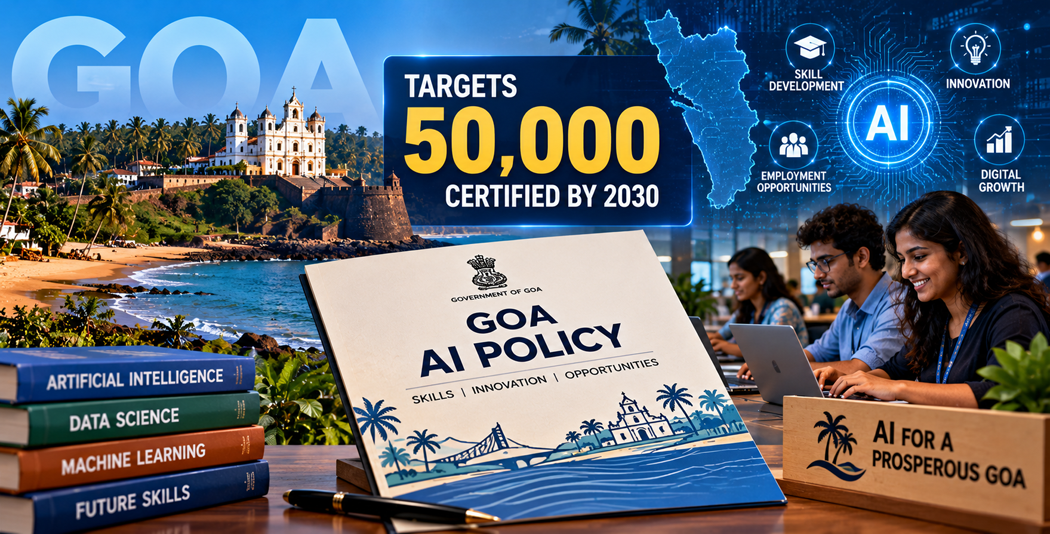
The Goa government has unveiled its Artificial Intelligence (AI) Policy 2026, setting a target of training and certifying 50,000 professionals by 2030 while planning to introduce AI education in schools and expand the technology’s use across governance, research and industry.
Chief Minister Pramod Sawant and Information Technology Minister Rohan Khaunte announced the policy at the Goa AI Tech Conclave 2026 in Panaji on October 22. According to reports by the Press Trust of India (PTI), the policy framework for 2026–2029 focuses on skill development, startup growth, investment, digital infrastructure and responsible AI adoption.
As part of the education initiative, the government plans to introduce AI fundamentals for students in Classes VI to XII from the 2027–28 academic year, according to The Times of India. The proposed curriculum aims to familiarise students with AI concepts and applications. Its implementation will require curriculum development, teacher training and suitable learning resources.
The policy also targets training and certifying 50,000 people by 2030 through multiple levels of learning, ranging from foundational AI knowledge to specialised skills. The initiative is intended to help students, graduates and working professionals build capabilities relevant to an increasingly AI- driven economy.
At the conclave, the state launched an AI hackathon featuring 100 problem statements from 35 government departments. The initiative aims to encourage participants to develop technology-based solutions for public services and government operations.
The government also signed a memorandum of understanding with BITS Pilani Goa to establish an AI Centre of Excellence. The proposed centre is expected to promote collaboration among academia, government and industry, while supporting AI research and practical applications.
Another key initiative is the proposed development of a Konkani large language model in collaboration with Digital India BHASHINI, with language-data contributions supported through BhashaDaan. The project aims to advance AI tools for Konkani speakers and improve access to digital services in the regional language.
The government has also outlined plans for an IT Techno Centre in Porvorim to support technology businesses, incubation and collaboration. Additional initiatives are expected to explore AI applications in tourism, governance and other public services.
The policy emphasises responsible and inclusive AI adoption. However, achieving its targets will depend on funding, institutional coordination, training capacity and the effective implementation of the proposed programmes.
The policy marks a step in Goa’s efforts to build an AI ecosystem spanning education, workforce development, research and public services. Progress on the certification target, school curriculum and planned infrastructure will be key indicators of its implementation.
