


26
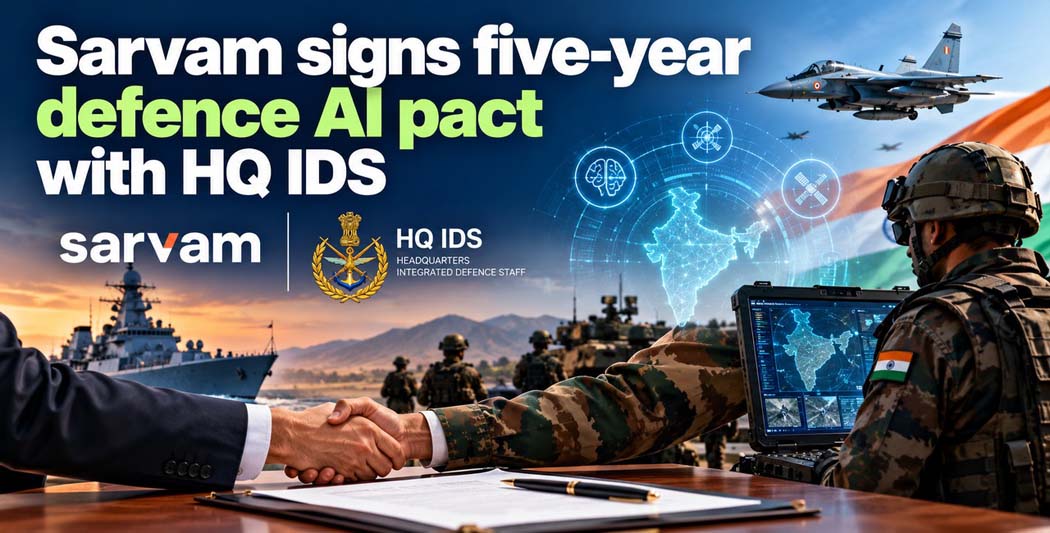
Indian AI company Sarvam has signed a five-year memorandum of understanding (MoU) with Headquarters Integrated Defence Staff (HQ IDS)
to develop artificial intelligence applications for the Indian Army, Navy and Air Force, establishing a common framework for AI projects across the three services.
Announced on October 27, 2026, the agreement covers AI applications for military operations, training and decision support. It also extends to joint, tri-service and integrated organisations under HQ IDS, which will coordinate engagement across the services.
Under the agreement, Sarvam will design, develop and deploy AI applications and provide technical support. Key focus areas include decision-support systems, target acquisition and data fusion across the sensor-to-shooter process, which connects information gathered by sensors with the assessment of potential threats and responses to them.
The framework will give the services access to shared foundation models, AI-agent infrastructure, and geospatial and perception systems, according to Sarvam. The common technology base is intended to allow knowledge and lessons from projects undertaken for one service to inform development across the others.
The work will be led by Chanakya, Sarvam’s division focused on national security and defence. It will use the company’s AI technology stack, including its Sarvam 105B foundation model, for the proposed projects.
The agreement also envisages building AI capabilities in India and deploying them on sovereign infrastructure. This approach supports efforts to strengthen domestic control over strategically important technologies and reduce dependence on externally controlled systems.
Sarvam said human oversight would be retained for operational decisions. How this safeguard works in practice will depend on the design, testing and deployment of individual applications, particularly where AI-assisted analysis informs military decisions.
The MoU establishes a framework for cooperation, but detailed project specifications, deployment schedules and financial terms have not been disclosed. The agreement does not, by itself, confirm that the proposed applications are already operational.
The partnership brings an Indian AI developer into a coordinated programme spanning all three armed services. Its longer-term impact will depend on the capabilities delivered, their reliability in military environments and the safeguards maintained during implementation.
