


23
GitHub has made Copilot Fusion generally available, introducing an AI-powered coding system that automatically selects and coordinates AI
models to complete software development tasks. The system aims to deliver performance close to leading coding agents while reducing the
average cost of completing a task.
Announced on October 28, 2026, Copilot Fusion combines automated model selection with a system that coordinates multiple models when a task requires additional reasoning or review.
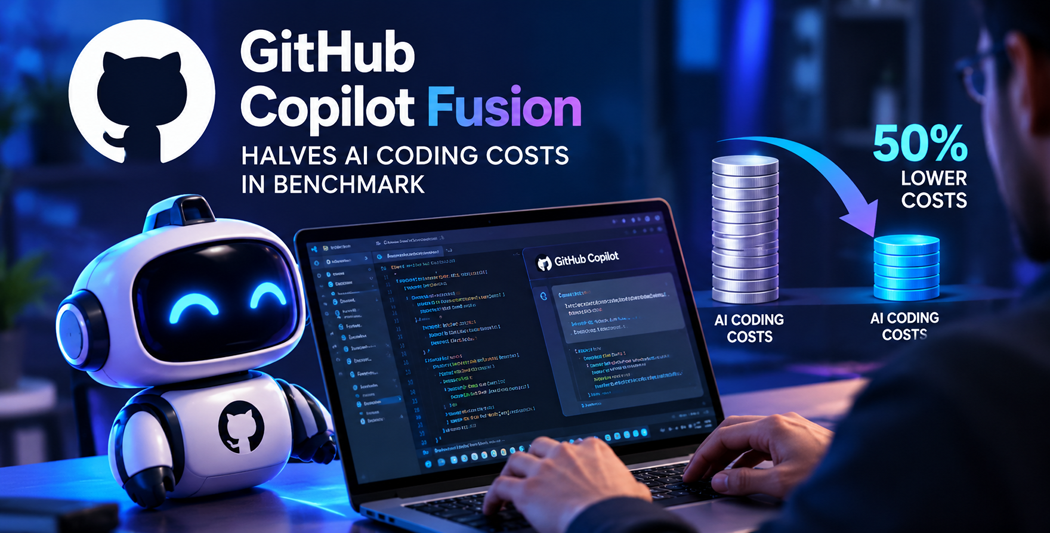
In an evaluation published by Artificial Analysis on October 28, Copilot Fusion Max scored 60 on the Coding Agent Index, placing it within two points of Claude Code running Claude Opus 5.5 Max. The evaluation recorded an average API cost of US$5.59 per task for Copilot Fusion, compared with US$11.42 for the competing configuration. This represents a reduction of approximately 51% in the tested configurations. The results are benchmark-specific and do not guarantee equivalent savings for individual developers or businesses.
Unlike a standalone AI model, Copilot Fusion acts as a model-routing and orchestration system. When a developer submits a coding request, it selects the models and workflow best suited to the task, considering factors such as reasoning requirements, coding capability and efficiency. This reduces the need for developers to manually switch between models as tasks become more complex.
The system uses three execution patterns. In the Single mode, one model handles the task directly. Cascade allows an initial model to draft a solution before a quality check determines whether the result should be accepted or passed to a stronger model. In Critique mode, one model prepares a draft, another reviews it, and the original model revises its response based on that feedback.
Developers can select from three principal effort levels. Fusion Standard is designed for everyday coding tasks, Fusion High prioritises more demanding assignments and deeper reasoning, while Fusion Max focuses on complex tasks requiring greater capabilities. GitHub also documents Fusion Fast for certain inline-chat scenarios in Visual Studio Code.
The benchmark results vary across individual evaluations. Copilot Fusion Max scored 71 on Terminal-Bench 4.0, 51 on FrontierCode and 57 on SWE-Atlas-QnA-AA, according to Artificial Analysis. The system led Terminal Bench 4.0 in the reported comparison but ranked behind competing configurations on FrontierCode. Its overall Coding Agent Index score should therefore not be interpreted as evidence that it performs best on every coding task.
GitHub says Copilot Fusion completed benchmark tasks approximately 40% faster while using about half as many tokens as the comparison configuration. Artificial Analysis also reported that Fusion used approximately 7.2 million tokens per task in its evaluation, around half the token usage of Claude Opus 5.5 in Claude Code. These findings reflect the tested setup and may differ in real-world development environments.
Copilot Fusion is available through Visual Studio Code, GitHub Copilot CLI, the GitHub Copilot app and JetBrains integrated development environments. The models it can use depend on the user's subscription, organisational policies and administrator settings.
The service does not carry a separate fee of its own. Instead, users are billed for the underlying models at their applicable rates. GitHub has also announced a temporary 30% discount on model costs for users on paid Copilot plans. The offer runs through November 30, 2026, and is separate from the savings reported in the independent benchmark.
For software teams, automatic model selection could help manage AI spending by using more capable models when tasks require them and more efficient options for routine work. However, benchmark performance alone does not establish how reliably the system will perform across different production codebases. Developers still need to test generated code, review security implications and examine proposed file changes before accepting them. GitHub also cautions that changes from discarded intermediate drafts may remain in the workspace rather than being automatically reversed.
Copilot Fusion reflects a broader shift in AI-assisted software development towards systems that coordinate multiple models instead of relying on one model for every request. Its reported results indicate that this approach can deliver competitive coding performance at a lower average task cost. Its practical value will depend on whether these gains translate into reliable outcomes across everyday development workflows.
