


27
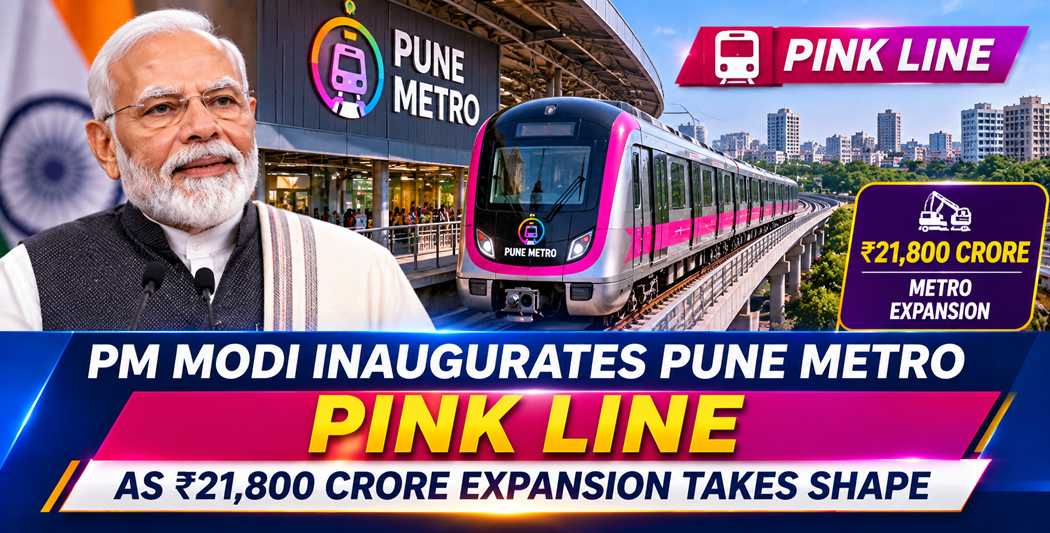
Prime Minister Narendra Modi inaugurated Pune Metro’s 23-kilometre Line 3, known as the Pink Line, on November 3, 2026, connecting Maan in
Hinjawadi with District Court station in Shivajinagar. Passenger services are scheduled to begin on November 4, with 17 of the corridor’s 23 stations opening initially. The remaining six stations are expected to become operational in phases by January 2027.
Built at a cost of Rs 8,313 crore, the elevated corridor connects Pune’s Hinjawadi information technology hub with the city centre, providing an additional commuting option for technology professionals and residents. It also connects with the existing metro network at District Court station. Developed under a public-private partnership (PPP) model, the line is expected to improve connectivity between the western employment district and central Pune.
According to the Prime Minister’s Office, the corridor will be operated by women train operators, while around 30 per cent of its electricity requirement is planned to be met through solar power.
At the same event, Modi laid the foundation stone for four additional corridors under Pune Metro Phase II. These proposed corridors have a combined estimated cost of Rs 13,484.09 crore. Together with the Pink Line, the projects represent an investment of approximately Rs 21,797 crore.
The approved Phase II package includes Line 2A, connecting Vanaz with Chandani Chowk, and Line 2B, extending from Ramwadi towards Wagholi and Vitthalwadi. These two corridors will cover a combined distance of 12.75 kilometres at an estimated cost of Rs 3,626.24 crore.
The other two proposed corridors are Line 4, which will connect Kharadi with Khadakwasla through Hadapsar and Swargate, and Line 4A, which will run from Nal Stop through Warje to Manik Baug. Together, these routes will cover 31.636 kilometres and involve an estimated investment of Rs 9,857.85 crore.
The planned extensions are aimed at strengthening connectivity between Pune’s residential neighbourhoods, commercial centres and information technology hubs. Their overall impact will depend on construction timelines, integration with existing metro services and passenger adoption.
