


22
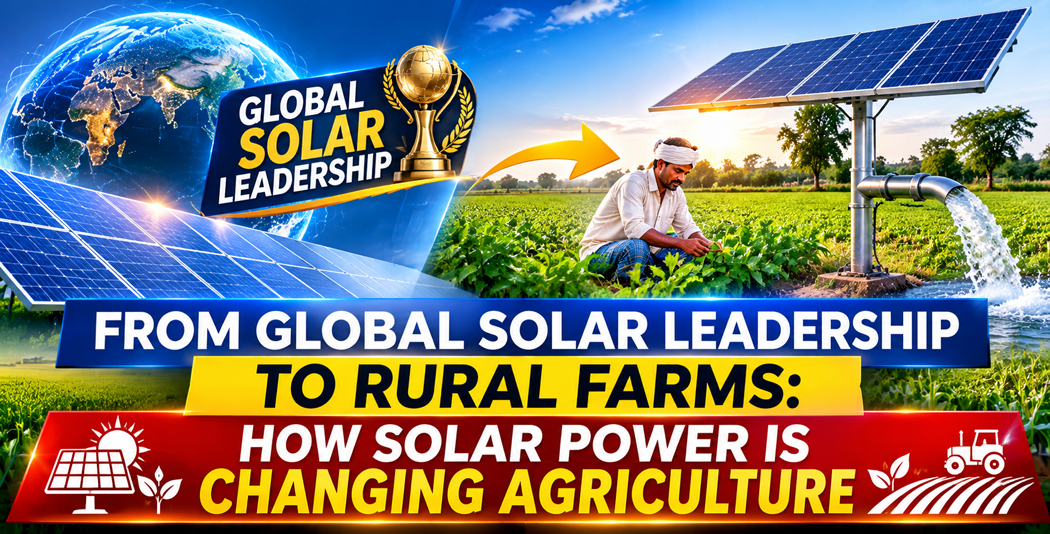
India’s continued leadership in the International Solar Alliance highlights the growing role of clean energy, while solar-powered irrigation is helping farmers in Jharkhand improve cultivation and rural livelihoods.
Solar energy is increasingly finding applications beyond electricity generation, with agriculture emerging as an important area where the technology can make a direct difference. From international cooperation on renewable energy to irrigation systems supporting farmers in rural India, solar power is creating new opportunities for communities.
India has been elected President of the International Solar Alliance (ISA) for a third consecutive term at the Alliance’s ninth session, held during the Bharat Renewable Energy Summit and Expo 2026. Union Minister for New and Renewable Energy Pralhad Joshi announced the development on November 3, reaffirming India’s commitment to expanding global solar cooperation. France was also re-elected as co-president of the Alliance.
Established by India and France in 2015, the International Solar Alliance now has 130 signatory and member countries. Its broader vision is to expand access to affordable and sustainable solar energy, particularly across developing countries.
Addressing the summit, Joshi highlighted initiatives aimed at making solar energy more accessible, including the Africa Solar Facility, solar and storage projects in island nations, and efforts to empower three million farmers through solar energy and agrivoltaics. He also pointed to India’s PM-KUSUM initiative as an example of how solar-powered agriculture can help reduce irrigation costs and create additional income opportunities.
While international partnerships are helping expand solar adoption, the impact of the technology is also visible at the grassroots level.
In parts of Jharkhand, where uneven terrain and limited access to irrigation water have made cultivation challenging, solar-powered lift irrigation systems are helping farmers bring more land under cultivation.
These systems use solar-powered pumps to draw water from nearby rivers and ponds and transport it through pipelines to agricultural fields. By reducing dependence on conventional electricity and fuel-powered pumps, the technology can lower irrigation expenses and support farming in areas where water access has traditionally been difficult.
The Jharkhand State Livelihood Promotion Society (JSLPS) is supporting irrigation initiatives across around 10 to 12 blocks, encouraging farmers to adopt solar-powered irrigation and improve agricultural productivity.
The impact can be seen in Khunti district, where farmer Kaisar Ali has developed a three-acre guava orchard in Shilda Bada Toli village. His orchard has around 5,000 Taiwan Pink guava plants and has reportedly produced approximately 20 tonnes of harvest this year, generating an income of around ₹20 lakh.
Ali began with vegetable cultivation after receiving support through a pump set provided by JSLPS. He later shifted towards guava cultivation, with the orchard becoming profitable after two years.
The benefits extend beyond agricultural production. Solar-powered irrigation is also creating local employment opportunities, particularly for women who can find work closer to their homes.
Ganga Kumari, who works in the area, said she earns around ₹400 a day through local employment. Such opportunities help rural workers earn an income without having to travel to cities such as Ranchi in search of work.
Jharkhand Chief Minister Hemant Soren has also emphasised the importance of combining traditional agricultural practices with technology, particularly as rainfall patterns become increasingly unpredictable. JSLPS CEO Ananya Mittal highlighted the role of lift irrigation projects and the need to encourage more solar-powered schemes.
India’s continued role in the International Solar Alliance reflects its efforts to strengthen international cooperation in renewable energy. At the same time, examples from Jharkhand demonstrate how solar technology can address practical challenges faced by farmers.
The applications of solar energy are expanding across irrigation, agricultural productivity, water management and rural employment. As countries work towards wider clean-energy adoption, solutions that directly benefit communities will remain an important part of the transition.
The shift is not just about generating electricity from sunlight. It is also about using that energy to support livelihoods, strengthen agriculture and make rural communities more resilient.
