


MIT Technology Review’s decision to name sodium-ion batteries as one of its 10 Breakthrough Technologies of 2026 reflects a scientific and commercial reality that has been building for years and is now crossing the threshold from promising research into large-scale deployable infrastructure. Academic researchers writing for The Conversation explain the chemistry, the economics, and the geopolitical significance of what may be one of the most consequential material science developments of the decade. Lithium-ion batteries — the dominant technology in electric vehicles, consumer electronics, and grid-scale energy storage — have a fundamental supply problem: lithium is concentrated in relatively few geographic locations, notably South America’s lithium triangle and parts of Australia, creating supply chains that are geopolitically concentrated and subject to price volatility. Sodium, by contrast, is one of the most abundant elements on Earth — essentially the same element as common table salt — and can be found in large quantities on every continent. Sodium-ion batteries use sodium ions rather than lithium ions to store and release electrical energy. Their energy density — the amount of energy stored per unit of weight or volume — is currently lower than that of premium lithium-ion cells, which means a sodium-ion electric vehicle would need a larger battery pack for the same driving range. However, sodium-ion batteries have several characteristics that make them superior to lithium-ion in specific applications: they retain their performance far more reliably in cold weather, they are significantly safer in the event of physical damage or overcharging, and their raw material cost is substantially lower. The combination of lower cost, cold-weather performance, and safety makes them particularly suitable for grid-scale energy storage — where energy density matters less than cost and reliability — and for affordable mass-market electric vehicles in price-sensitive markets. CATL, the world’s largest electric vehicle battery manufacturer, has committed to mass production of sodium-ion batteries by the end of 2026. Peak Energy in the United States is already deploying sodium-ion cells in grid-scale storage systems. Academic researchers argue that if CATL and other manufacturers can achieve planned production volumes, sodium-ion batteries could open sub-$20,000 electric vehicle market segments that have been priced out of electrification, while simultaneously providing a resilient, geopolitically independent alternative for the grid storage systems essential to integrating large-scale renewable energy.
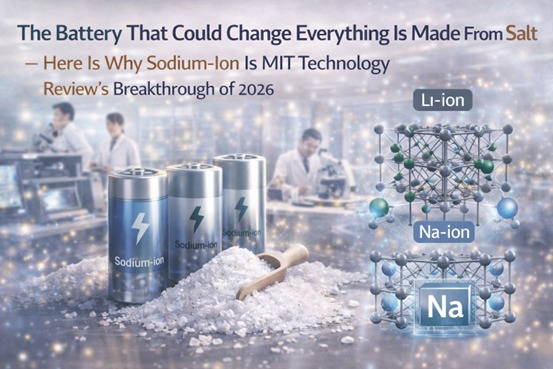
The Battery That Could Change Everything Is Made From Salt — Here Is Why Sodium-Ion Is MIT Technology Review’s Breakthrough of 2026
108
