


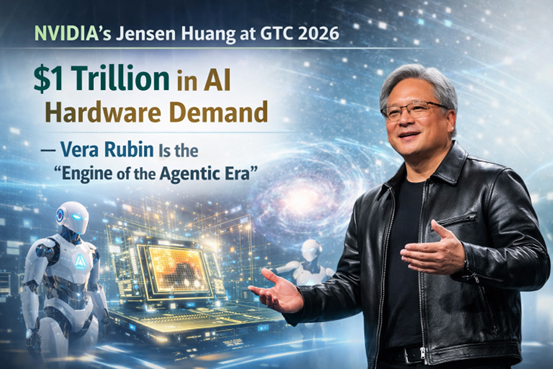
NVIDIA CEO Jensen Huang delivered the keynote at the company’s annual GTC developer conference at the SAP Center in San Jose, California on March 16, 2026, before a capacity audience of more than 10,000 people and tens of thousands more watching the public livestream globally. The headline figure was striking: Huang told attendees and investors that NVIDIA now sees at least $1 trillion in high-confidence demand and purchase orders for its Blackwell and Vera Rubin AI hardware platforms through 2027. That figure is double the $500 billion projection he made at GTC 2025 one year ago — and Huang added that he is personally confident total computing demand will exceed even that elevated number. The flagship hardware announcement was the Vera Rubin platform, confirmed by NVIDIA’s official newsroom as the company’s most ambitious AI infrastructure system to date. Vera Rubin is a fully vertically integrated, agentic AI computing platform integrating seven specialised chips across five rack-scale systems operating as a single unified supercomputer. NVIDIA states it delivers 700 million tokens per second in a one-gigawatt factory — compared to approximately 2 million tokens per second with the Hopper generation hardware just two years ago. That is a 350-times improvement in two years, a rate of progress that Huang said exceeds Moore’s Law. In performance terms, the Vera Rubin Ultra platform can connect up to 144 GPUs and is designed specifically for always-on, long-running agentic AI workloads — software that can see, plan, act, and continuously improve without human prompting. Huang also confirmed that NVIDIA expects to produce thousands of Vera Rubin systems per week, representing multi-gigawatts of AI factory capacity per month within the supply chain. On robotics and autonomous vehicles: Huang announced that Nissan, BYD, Geely, Hyundai, and Isuzu are all building Level 4 autonomous vehicles on NVIDIA’s Drive Hyperion programme. Uber confirmed integration of NVIDIA-powered robotaxi-ready vehicles into its platform. A Disney-developed Olaf robot — the snowman character from Frozen — appeared on stage, walking and talking, entirely powered by NVIDIA’s physical AI stack, the Newton physics engine, and NVIDIA Omniverse simulation. The robot had been trained entirely inside an NVIDIA simulation environment, never having practised its movements in the physical world prior to the live demonstration.
NVIDIA’s Jensen Huang at GTC 2026: $1 Trillion in AI Hardware Demand — Vera Rubin Is the ‘Engine of the Agentic Era’
76
