


21
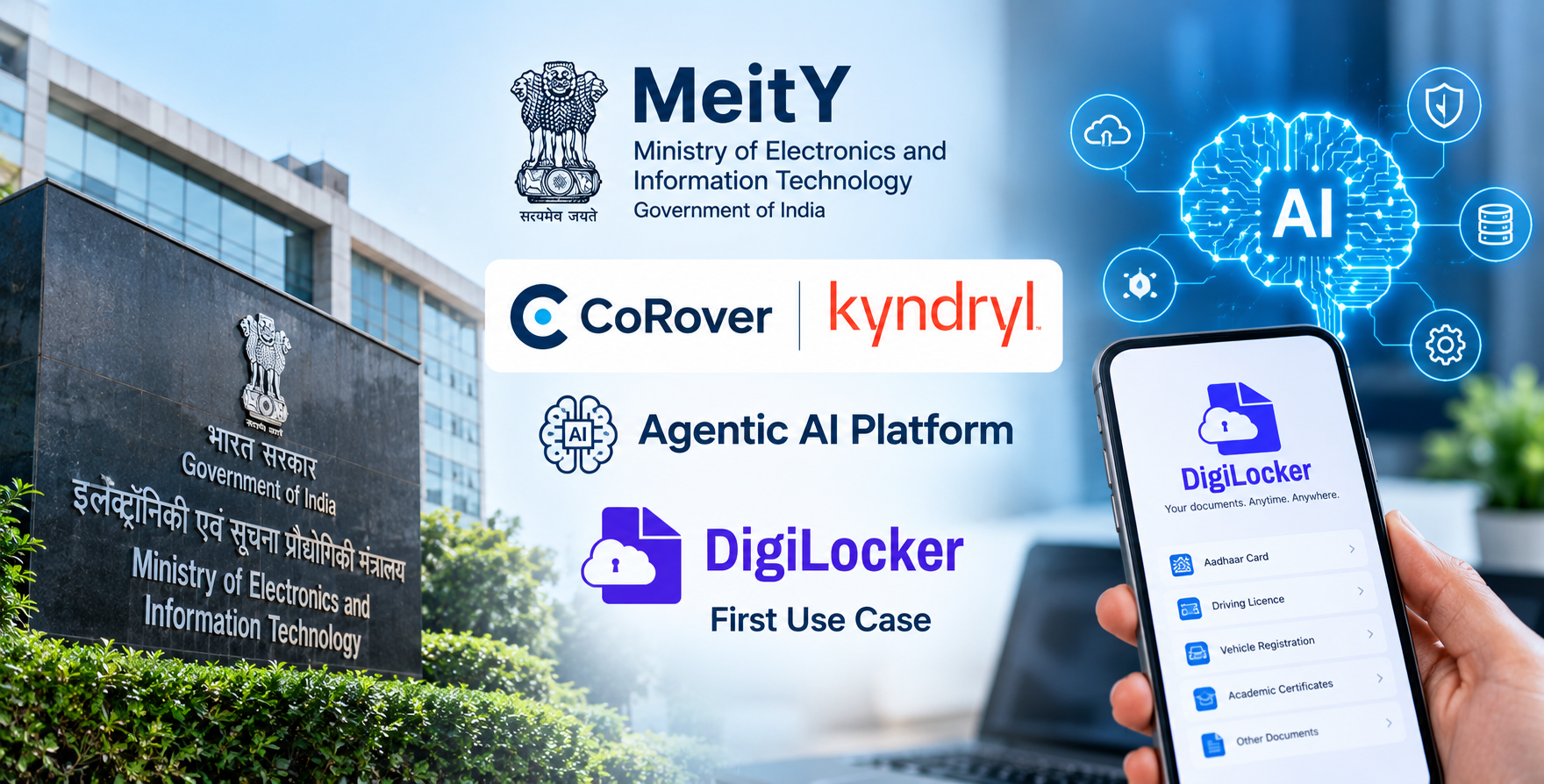
The Ministry of Electronics and Information Technology (MeitY) has reportedly shortlisted CoRover and Kyndryl Solutions for a proposed government-wide agentic AI platform, following a
technical evaluation conducted by the National e-Governance Division (NeGD).
Unlike conventional government chatbots that mainly respond to queries, the proposed platform is designed to allow AI agents to take authorised actions, complete transactions and escalate cases to human officials when required.
According to a NeGD evaluation notice reported by Moneycontrol, CoRover and Kyndryl qualified in the technical evaluation, while Cactus Technology Solutions and NEC Corporation India were disqualified at this stage. The technical bids were opened on September 7 and subsequently assessed by a Technical Evaluation Committee.
DigiLocker is expected to become the first implementation of the proposed platform and will serve as its minimum viable product.
The agent is expected to help users with tasks such as finding and securely sharing documents,managing their digital document records, and accessing information after receiving the necessary authentication and consent.
The proposed system follows an “Ask, Do and Escalate” approach. This means users could ask the AI to perform an authorised task rather than simply provide instructions. Cases requiring human intervention could then be escalated to officials.
The larger plan is to create a reusable AI framework that government departments can use for different services without having to build a separate AI system from scratch for every application.
The proposed architecture is expected to support authentication through Parichay and DigiLocker, consent management, audit trails, and multiple Indian languages. The platform is also being designed to support both SaaS APIs and on-premises deployment.
The government is seeking a technology stack that uses open-source and open-weight components, with the aim of reducing dependence on a single proprietary AI or cloud provider. The DigiLocker implementation is reportedly planned for a four-month development period, followed by 12 months of operations and maintenance.
If implemented as planned, the framework could allow government departments to introduce AI agents capable of handling specific tasks and transactions while retaining human intervention for cases that require additional oversight.
Unlike conventional government chatbots that mainly respond to queries, the proposed platform is designed to allow AI agents to take authorised actions, complete transactions and escalate cases to human officials when required.
According to a NeGD evaluation notice reported by Moneycontrol, CoRover and Kyndryl qualified in the technical evaluation, while Cactus Technology Solutions and NEC Corporation India were disqualified at this stage. The technical bids were opened on September 7 and subsequently assessed by a Technical Evaluation Committee.
DigiLocker is expected to become the first implementation of the proposed platform and will serve as its minimum viable product.
The agent is expected to help users with tasks such as finding and securely sharing documents,managing their digital document records, and accessing information after receiving the necessary authentication and consent.
The proposed system follows an “Ask, Do and Escalate” approach. This means users could ask the AI to perform an authorised task rather than simply provide instructions. Cases requiring human intervention could then be escalated to officials.
The larger plan is to create a reusable AI framework that government departments can use for different services without having to build a separate AI system from scratch for every application.
The proposed architecture is expected to support authentication through Parichay and DigiLocker, consent management, audit trails, and multiple Indian languages. The platform is also being designed to support both SaaS APIs and on-premises deployment.
The government is seeking a technology stack that uses open-source and open-weight components, with the aim of reducing dependence on a single proprietary AI or cloud provider. The DigiLocker implementation is reportedly planned for a four-month development period, followed by 12 months of operations and maintenance.
If implemented as planned, the framework could allow government departments to introduce AI agents capable of handling specific tasks and transactions while retaining human intervention for cases that require additional oversight.
