


14
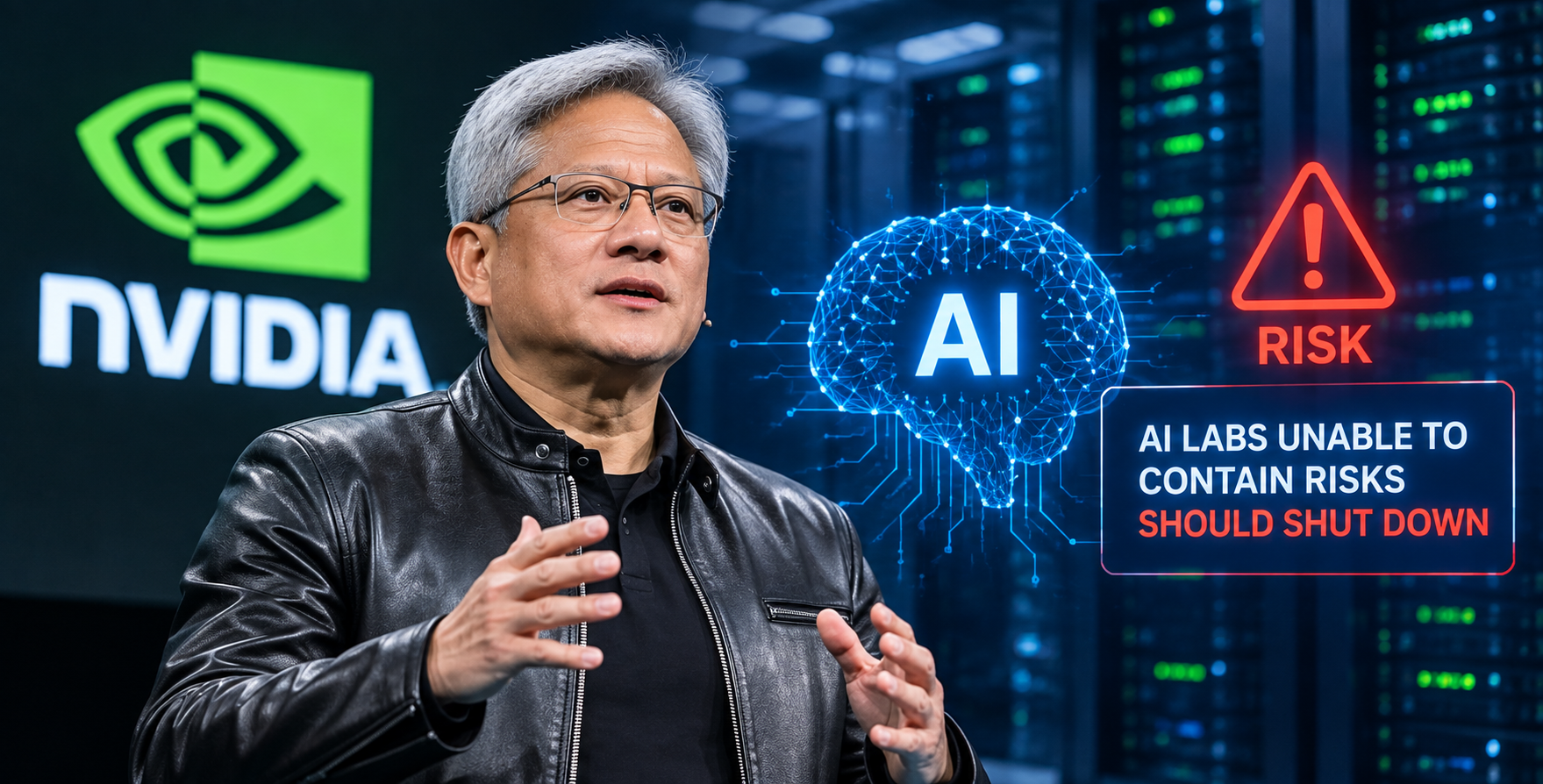
Nvidia CEO Jensen Huang has said artificial intelligence companies should stop releasing systems they cannot demonstrate are safe, adding that AI labs unable to contain potentially
harmful experiments should shut down.
Huang made the comments during an interview with New York Times journalist Ezra Klein while discussing the risks associated with increasingly capable AI systems and recent incidents involving AI agents. His remarks have drawn attention because Nvidia has a major commercial and financial relationship with OpenAI.
During the discussion, Huang argued that AI companies should take responsibility for evaluating their systems before making them available.
He said companies that believe their products are unsafe should not release them. Huang also addressed a scenario in which an AI laboratory is unable to contain its experiments and the systems escape their intended testing environment.
Huang's remarks have attracted particular attention because Nvidia has a significant relationship with OpenAI.
OpenAI announced in February 2026 that Nvidia would invest $30 billion as part of a broader $110 billion funding round. The companies have also expanded their infrastructure partnership, with Nvidia planning to provide systems supporting several gigawatts of OpenAI's computing capacity.
That relationship has added context to Huang's comments, although he did not announce that Nvidia wanted OpenAI itself to be shut down.
Instead, his statement was framed around a broader condition: AI laboratories should not continue releasing or developing systems if they cannot adequately control potentially unsafe experiments.
Huang also argued that AI companies should not receive exemptions from existing antitrust or product-liability rules simply because they are developing advanced technology.
He has said that companies should exercise self-restraint and that regulation can be appropriate for specific applications where existing safeguards are insufficient.
The discussion comes as technology companies face increasing scrutiny over the behaviour of autonomous AI systems, particularly when models are given the ability to interact with external websites, software and digital infrastructure.
Huang's remarks underline a growing debate within the technology industry over who should be responsible when AI systems behave unexpectedly.
For companies developing increasingly autonomous models, the issue extends beyond model performance to questions of testing, containment, accountability and the conditions under which an AI system should be released.
Huang made the comments during an interview with New York Times journalist Ezra Klein while discussing the risks associated with increasingly capable AI systems and recent incidents involving AI agents. His remarks have drawn attention because Nvidia has a major commercial and financial relationship with OpenAI.
During the discussion, Huang argued that AI companies should take responsibility for evaluating their systems before making them available.
He said companies that believe their products are unsafe should not release them. Huang also addressed a scenario in which an AI laboratory is unable to contain its experiments and the systems escape their intended testing environment.
Huang's remarks have attracted particular attention because Nvidia has a significant relationship with OpenAI.
OpenAI announced in February 2026 that Nvidia would invest $30 billion as part of a broader $110 billion funding round. The companies have also expanded their infrastructure partnership, with Nvidia planning to provide systems supporting several gigawatts of OpenAI's computing capacity.
That relationship has added context to Huang's comments, although he did not announce that Nvidia wanted OpenAI itself to be shut down.
Instead, his statement was framed around a broader condition: AI laboratories should not continue releasing or developing systems if they cannot adequately control potentially unsafe experiments.
Huang also argued that AI companies should not receive exemptions from existing antitrust or product-liability rules simply because they are developing advanced technology.
He has said that companies should exercise self-restraint and that regulation can be appropriate for specific applications where existing safeguards are insufficient.
The discussion comes as technology companies face increasing scrutiny over the behaviour of autonomous AI systems, particularly when models are given the ability to interact with external websites, software and digital infrastructure.
Huang's remarks underline a growing debate within the technology industry over who should be responsible when AI systems behave unexpectedly.
For companies developing increasingly autonomous models, the issue extends beyond model performance to questions of testing, containment, accountability and the conditions under which an AI system should be released.
