


19
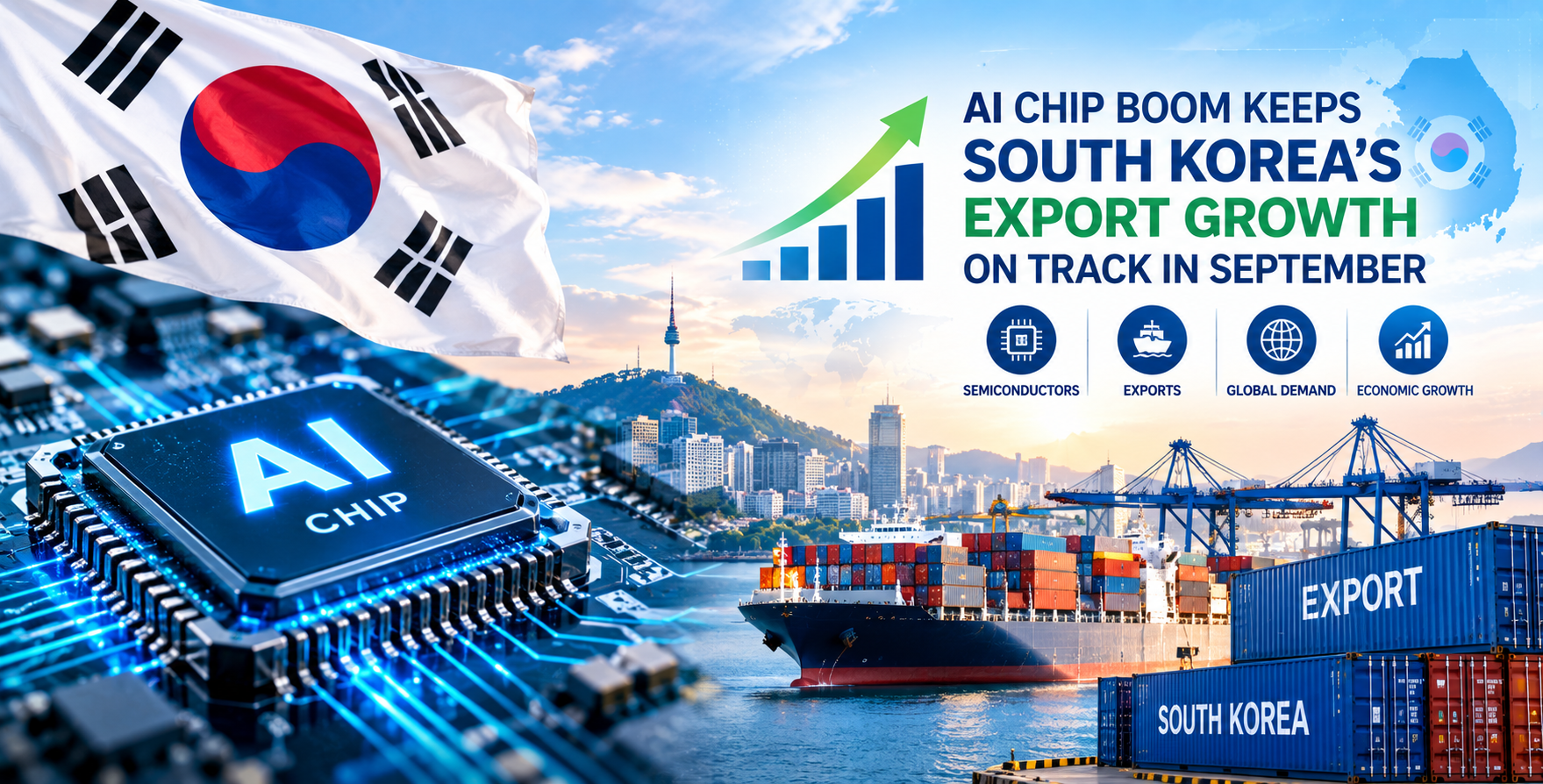
South Korea’s exports are expected to post another strong increase in September, with booming demand for semiconductors used in artificial
intelligence systems continuing to support the country’s international trade.
Exports from Asia’s fourth-largest economy are projected to rise 62.0% from a year earlier, according to the median estimate in a Reuters poll of 18 economists. The forecast follows a 68.7% increase in August and would mark the fourth straight month of exceptionally strong annual growth, although the pace is expected to ease in September.
The anticipated slowdown is largely linked to the number of working days rather than a sharp deterioration in demand. South Korea had about 21.5 working days this month, compared with 24 days a year earlier, because of the different timing of the Chuseok holiday.
Trade figures for the first 20 days of September showed that export activity remained particularly strong. Shipments increased 78.3% from a year earlier, reaching a record for the period, while semiconductor exports jumped 259.4%. On a working-day-adjusted basis, exports were up 89.8%.
The performance highlights the growing contribution of semiconductors to South Korea’s export economy as global technology companies continue to increase spending on AI infrastructure.
Analysts expect the semiconductor export boom to remain supported by continued investment from major AI technology companies and hyperscalers.
South Korea’s exports have maintained strong growth since June 2025, benefiting from the global expansion of AI-related investment. Annual export growth has remained in double digits since December, while June recorded a 70.4% increase, the strongest annual pace in nearly five decades.
Demand for chips used in AI servers, data centres and other advanced computing systems has become an important source of momentum for South Korea’s export sector. The strength of semiconductor shipments has also helped bolster the country’s trade position despite the expected moderation in September’s headline growth rate.
Imports are projected to increase 21.5% year on year in September, following a 22.4% rise in August.
Economists expect South Korea to record a monthly trade surplus of around $38.15 billion, which would surpass the $34.79 billion surplus reported for August and mark a new monthly record.
South Korea is due to publish its official September trade figures on October 1 at 9 a.m. local time (0000 GMT). The data will provide further insight into the strength of the country’s semiconductor exports and the continuing influence of global AI investment on South Korea’s trade performance.
Exports from Asia’s fourth-largest economy are projected to rise 62.0% from a year earlier, according to the median estimate in a Reuters poll of 18 economists. The forecast follows a 68.7% increase in August and would mark the fourth straight month of exceptionally strong annual growth, although the pace is expected to ease in September.
The anticipated slowdown is largely linked to the number of working days rather than a sharp deterioration in demand. South Korea had about 21.5 working days this month, compared with 24 days a year earlier, because of the different timing of the Chuseok holiday.
Trade figures for the first 20 days of September showed that export activity remained particularly strong. Shipments increased 78.3% from a year earlier, reaching a record for the period, while semiconductor exports jumped 259.4%. On a working-day-adjusted basis, exports were up 89.8%.
The performance highlights the growing contribution of semiconductors to South Korea’s export economy as global technology companies continue to increase spending on AI infrastructure.
Analysts expect the semiconductor export boom to remain supported by continued investment from major AI technology companies and hyperscalers.
South Korea’s exports have maintained strong growth since June 2025, benefiting from the global expansion of AI-related investment. Annual export growth has remained in double digits since December, while June recorded a 70.4% increase, the strongest annual pace in nearly five decades.
Demand for chips used in AI servers, data centres and other advanced computing systems has become an important source of momentum for South Korea’s export sector. The strength of semiconductor shipments has also helped bolster the country’s trade position despite the expected moderation in September’s headline growth rate.
Imports are projected to increase 21.5% year on year in September, following a 22.4% rise in August.
Economists expect South Korea to record a monthly trade surplus of around $38.15 billion, which would surpass the $34.79 billion surplus reported for August and mark a new monthly record.
South Korea is due to publish its official September trade figures on October 1 at 9 a.m. local time (0000 GMT). The data will provide further insight into the strength of the country’s semiconductor exports and the continuing influence of global AI investment on South Korea’s trade performance.
