


19
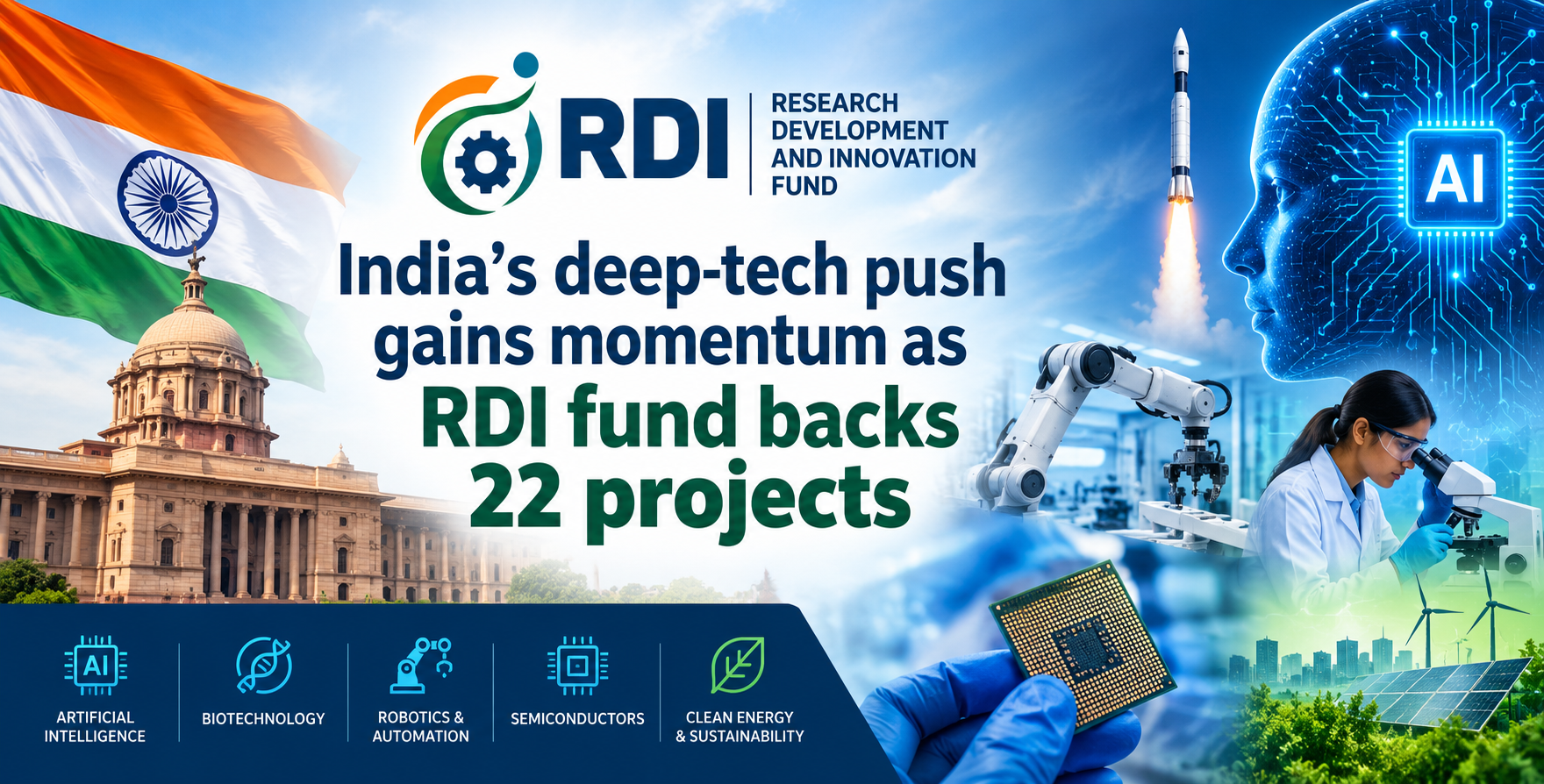
India’s deep-tech ecosystem is gaining fresh momentum as the government’s Rs 1 lakh crore Research, Development and Innovation (RDI) Fund moves into project-level deployment.
The Technology Development Board (TDB), one of the Second-Level Fund Managers under the RDI Fund, has approved 22 projects with a combined project cost of Rs 4,744 crore, with Rs 2,192 crore in support from the RDI Fund, according to government data.
Dr Sudhir Mehta, a member of the TDB Investment Committee, said in a post on X that 14 of the 22 projects are startups and that 13 fall into deep-tech areas. He highlighted technologies including reusable launch vehicles, Earth-observation satellites, quantum-secure communications, indigenous chip design, drones, robotics and next-generation batteries.
The projects span several Indian technology hubs, including Bengaluru, Chennai, Hyderabad, Mumbai, Thane, Noida and Pune, according to Mehta.
The government’s RDI scheme was approved by the Union Cabinet in July 2025 with an overall outlay of Rs 1 lakh crore over six years. It was formally launched in November 2025 with the objective of increasing private-sector participation in research, development and commercialisation of indigenous technologies.
The scheme is designed to provide long-term, relatively low-cost financing for research-driven and deep-tech projects. Under the TDB framework, eligible projects can receive collateral-free long-term loans, with financing available for up to 50% of project costs and a tenure of up to 15 years for qualifying projects.
The first group of projects covers strategic areas including space technology, quantum computing, robotics, electric mobility, semiconductor and telecom technologies, healthcare, biotechnology, energy storage and climate technologies. Business Standard reported that beneficiaries include companies such as The ePlane Company, Ather Energy, Agnikul Cosmos, ideaForge and Tejas Networks.
Mehta said the experience of reviewing proposals had increased his confidence in the depth of India’s technology pipeline. He argued that access to patient capital has historically been a challenge for Indian deep-tech companies because technologies often require long development cycles before reaching commercial scale.
The RDI Fund is intended to address part of that financing gap by providing longer-term funding to technology companies developing strategic and research-intensive products.
The initial approvals also indicate the breadth of India's emerging deep-tech landscape, ranging from space and quantum communications to drones, robotics, batteries and semiconductor technologies.
The government says the broader RDI programme is intended to help transform indigenous research and innovation into globally competitive technologies while encouraging greater private-sector investment in R&D.
With the first 22 projects now approved through TDB, attention will shift to how quickly these technologies move from research and development to commercial deployment and how effectively the wider Rs 1 lakh crore programme can expand access to long-term capital for Indian technology companies.
The Technology Development Board (TDB), one of the Second-Level Fund Managers under the RDI Fund, has approved 22 projects with a combined project cost of Rs 4,744 crore, with Rs 2,192 crore in support from the RDI Fund, according to government data.
Dr Sudhir Mehta, a member of the TDB Investment Committee, said in a post on X that 14 of the 22 projects are startups and that 13 fall into deep-tech areas. He highlighted technologies including reusable launch vehicles, Earth-observation satellites, quantum-secure communications, indigenous chip design, drones, robotics and next-generation batteries.
The projects span several Indian technology hubs, including Bengaluru, Chennai, Hyderabad, Mumbai, Thane, Noida and Pune, according to Mehta.
The government’s RDI scheme was approved by the Union Cabinet in July 2025 with an overall outlay of Rs 1 lakh crore over six years. It was formally launched in November 2025 with the objective of increasing private-sector participation in research, development and commercialisation of indigenous technologies.
The scheme is designed to provide long-term, relatively low-cost financing for research-driven and deep-tech projects. Under the TDB framework, eligible projects can receive collateral-free long-term loans, with financing available for up to 50% of project costs and a tenure of up to 15 years for qualifying projects.
The first group of projects covers strategic areas including space technology, quantum computing, robotics, electric mobility, semiconductor and telecom technologies, healthcare, biotechnology, energy storage and climate technologies. Business Standard reported that beneficiaries include companies such as The ePlane Company, Ather Energy, Agnikul Cosmos, ideaForge and Tejas Networks.
Mehta said the experience of reviewing proposals had increased his confidence in the depth of India’s technology pipeline. He argued that access to patient capital has historically been a challenge for Indian deep-tech companies because technologies often require long development cycles before reaching commercial scale.
The RDI Fund is intended to address part of that financing gap by providing longer-term funding to technology companies developing strategic and research-intensive products.
The initial approvals also indicate the breadth of India's emerging deep-tech landscape, ranging from space and quantum communications to drones, robotics, batteries and semiconductor technologies.
The government says the broader RDI programme is intended to help transform indigenous research and innovation into globally competitive technologies while encouraging greater private-sector investment in R&D.
With the first 22 projects now approved through TDB, attention will shift to how quickly these technologies move from research and development to commercial deployment and how effectively the wider Rs 1 lakh crore programme can expand access to long-term capital for Indian technology companies.
