


24
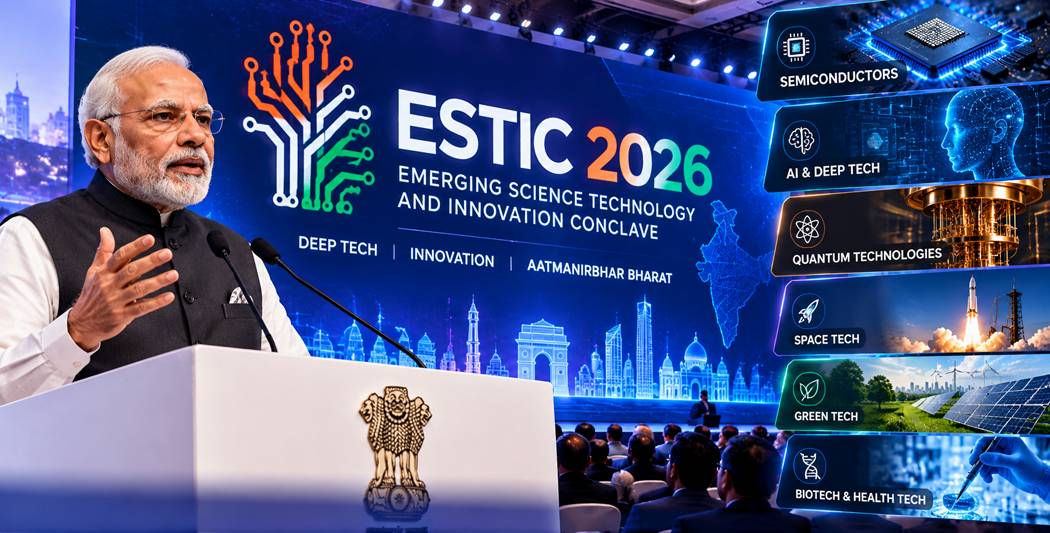
Prime Minister Narendra Modi is scheduled to inaugurate the Emerging Science, Technology and Innovation Conclave (ESTIC) 2026 in New Delhi
on October 27. The three-day event will bring together Nobel laureates, researchers, policymakers, industry leaders and deep-tech startups to
discuss India’s science and technology priorities.
The conclave will be held at Bharat Mandapam from October 27 to 29, with the inauguration scheduled for 5:30 PM IST. According to official announcements, the event will feature three Nobel laureates: Joachim Frank, Sir Richard J. Roberts and Kostya Novoselov.
ESTIC 2026 will cover 12 thematic areas, including artificial intelligence (AI), biotechnology, advanced materials, manufacturing, healthcare, energy, climate and ocean sciences. The programme will include plenary talks, technical sessions, panel discussions and presentations exploring scientific advances and their potential applications.
An accompanying technology and innovation exhibition will showcase emerging technologies and research-led innovations through around 150 deep-tech startup stalls. Visitors will be able to explore demonstrations, thematic videos, informational displays and augmented and virtual reality experiences. The exhibition is scheduled to open to the public on the second day of the conclave.
The Global Connect Networking Event will bring together more than 300 invited participants from academic institutions, research organisations and industry in India and abroad. It aims to encourage international research partnerships, strengthen collaboration between universities and businesses, and explore ways to translate laboratory innovations into commercial applications.
The government has also emphasised the need to build stronger connections between scientific research, startups, industry and markets. At the September curtain-raiser for ESTIC 2026, Union Minister of State for Science and Technology Jitendra Singh called for a roadmap with short- and long-term milestones to ensure that discussions at the conclave contribute to sustained progress beyond the event.
Turning scientific breakthroughs into commercially viable technologies remains a key challenge for India’s deep-tech sector. Progress depends not only on research but also on access to funding, technical expertise, industrial infrastructure and potential customers.
The partnerships and follow-up initiatives emerging from ESTIC 2026 will therefore be important in assessing its practical impact, particularly in moving innovations from research laboratories towards manufacturing, commercialisation and wider adoption.
The Council of Scientific and Industrial Research (CSIR) is organising the conclave under the guidance of the Office of the Principal Scientific Adviser to the Government of India. CSIR–National Institute for Interdisciplinary Science and Technology (CSIR-NIIST) is serving as the organising partner.
The event’s theme is “Creative Minds, Catalyzing Science, Empowering Technologies.” By bringing researchers, policymakers, entrepreneurs and industry representatives together, ESTIC 2026 aims to strengthen collaboration across India’s science and technology ecosystem. Its longer- term significance will depend on the research partnerships, technology development and commercial applications that follow.
