


29
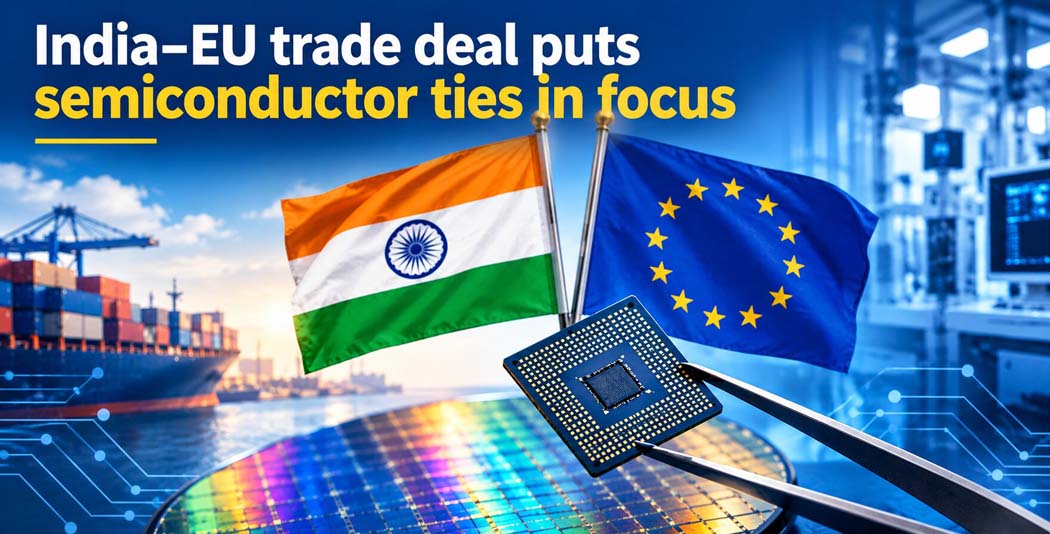
India’s proposed free-trade agreement with the European Union could create new opportunities for the country’s semiconductor and electronics
industries by complementing existing cooperation in research, advanced technology and manufacturing.
A key example is the growing engagement between India’s semiconductor ecosystem and Belgium-based imec, a leading research and innovation institute specialising in nanoelectronics and digital technologies.
During Belgian Prime Minister Bart De Wever’s visit to India from September 2 to 4, the two countries encouraged closer collaboration between imec and Indian semiconductor companies, the ChipIN Centre, the Centre for Development of Advanced Computing (C-DAC) and universities.
In a joint statement issued on September 3, the governments supported efforts to develop these interactions into deeper partnerships in semiconductor technologies. The objective is to strengthen advanced technology capabilities and build more resilient ecosystems in both countries.
The initiative highlights the importance of connecting research institutions, universities and industry to develop technical expertise and explore practical applications. However, the statement did not announce a new semiconductor fabrication plant, a specific investment commitment or a commercial production agreement.
India–EU technology cooperation gains momentum The broader India–EU relationship provides additional context for these initiatives. At the third meeting of the EU–India Trade and Technology Council in Brussels on July 15, the two sides advanced discussions on cooperation in semiconductors, high-performance computing, quantum technologies, artificial intelligence and 6G.
These discussions reflect a shared interest in strengthening technology supply chains and expanding collaboration between businesses and research institutions.
India and the EU concluded negotiations on their free-trade agreement on January 27, 2026. On September 11, the European Commission submitted proposals to the Council of the European Union seeking authorisation for the agreement’s signature and conclusion.
The agreement has not yet entered into force and must complete the applicable approval procedures.
What the trade agreement could mean for the semiconductor industry The proposed agreement is intended to improve market access and establish more predictable rules for trade and investment. Its implications for semiconductor equipment, electronic components and finished products will depend on the final provisions, tariff schedules, rules of origin and applicable regulatory requirements.
However, trade access alone cannot guarantee the expansion of semiconductor manufacturing. Fabrication facilities require substantial capital, specialised equipment, reliable supplies of materials, advanced infrastructure and highly skilled workers.
Research partnerships can strengthen technical capabilities, but they do not automatically translate into new manufacturing capacity or commercially viable production.
India’s opportunity lies in converting international cooperation into measurable outcomes, including stronger chip-design capabilities, advanced research programmes, industry–academia partnerships and higher-value electronics manufacturing. European research institutions and businesses could also benefit from closer engagement with India’s growing technology sector and industrial market.
Ultimately, the proposed India–EU trade agreement could complement existing research and technology initiatives by providing a broader framework for economic cooperation. Its impact on the semiconductor industry will depend on implementation and whether policy-level engagement leads to concrete research partnerships, investment and commercial projects.
