


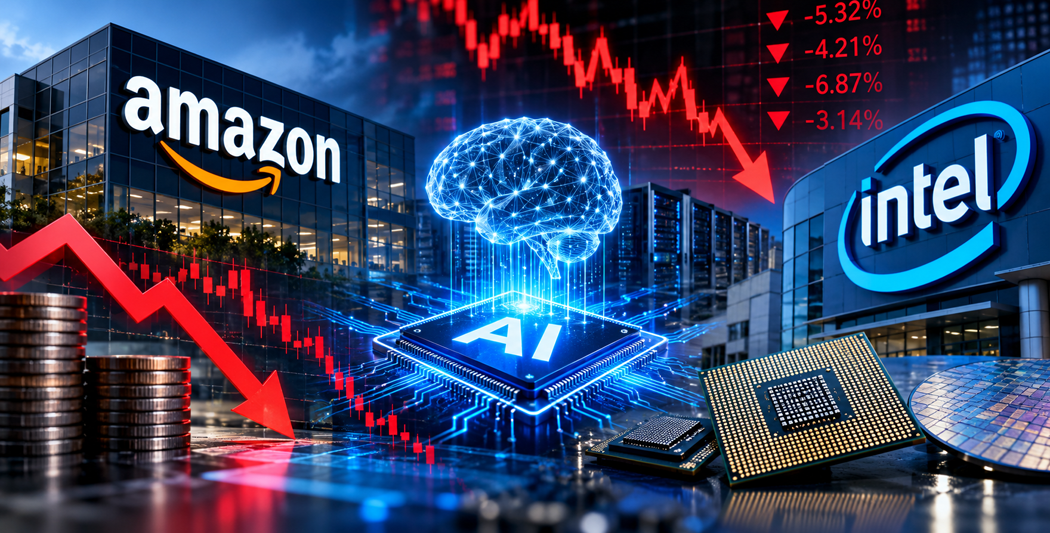
The growing cost of the artificial intelligence (AI) boom is creating fresh challenges for global technology companies. Amazon’s rising investment in AI infrastructure and Intel’s warning about weakening personal computer (PC) demand have raised concerns over the sustainability of the industry’s rapid expansion.
Amazon reported third-quarter net sales of $201.9 billion, marking a 12 per cent increase year-on-year. Its cloud computing division, Amazon Web
Services (AWS), recorded revenue growth of 39.3 per cent to $46 billion.
However, the company’s free cash flow turned negative, recording an outflow of $42.4 billion over the 12 months ending September 30. The
decline was largely attributed to increased spending on infrastructure, equipment and AI-related investments. Amazon expects its capital
expenditure to reach approximately $220 billion in 2026.
The company also projected fourth-quarter revenue between $240 billion and $247 billion, with the midpoint falling below Wall Street expectations.Its shares declined approximately 7 per cent in after-hours trading following the announcement.
Meanwhile, Intel reported third-quarter revenue of $16.51 billion, up 21 per cent year-on-year. However, its PC chip business recorded a 5 per cent decline to $8.1 billion, as rising memory prices and supply constraints added pressure to computer manufacturers.
Intel expects these challenges to continue through at least the first half of 2027. In contrast, its Data Center and AI business delivered stronger growth, with revenue increasing 78 per cent to $7.3 billion.
Despite the growth in its AI segment, Intel’s fourth-quarter revenue forecast of $15 billion to $16 billion fell short of analysts’ expectations of $17.07 billion. Its shares dropped approximately 18 per cent in after-hours trading.
The company also expects an explosion at its Kiryat Gat facility in Israel to affect revenue by approximately $600 million across the fourth quarter of 2026 and the first quarter of 2027.
The concerns have also affected companies involved in AI infrastructure and semiconductor manufacturing, including CoreWeave, Nebius, IREN,
AMD and Broadcom. The Philadelphia Semiconductor Index had retreated 13 per cent from its October peak and 21 per cent from its June record.
The developments highlight a growing challenge for the technology industry: balancing massive AI infrastructure investments with rising
operating costs, supply constraints and the need to generate sustainable returns.
As companies continue expanding their AI capabilities, investors are increasingly looking beyond growth figures to assess whether these
investments can translate into long-term business value.
