


30
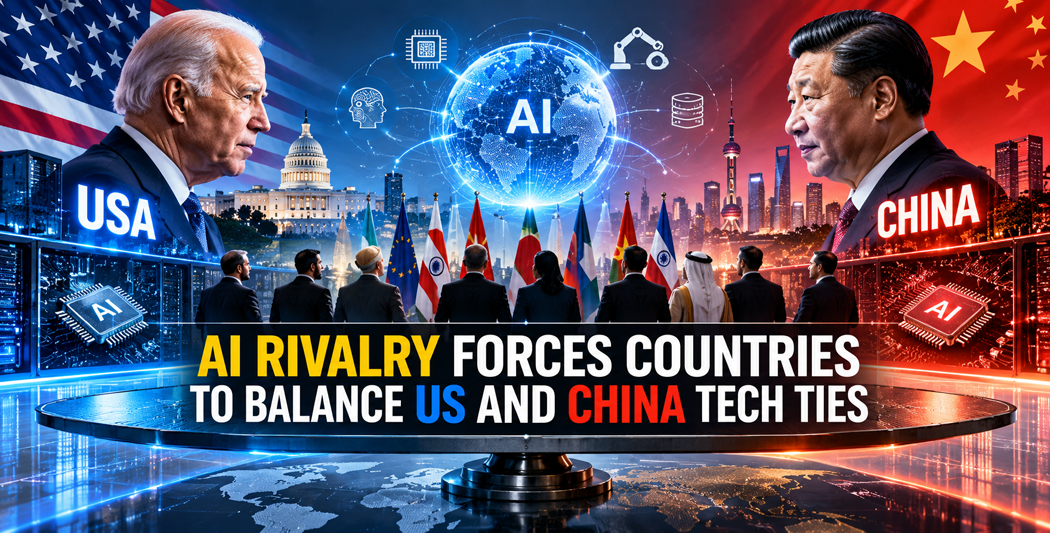
Countries worldwide are seeking access to advanced artificial intelligence (AI) technology from the United States and China while trying to avoid
dependence on either power. As Washington and Beijing expand competing technology partnerships, governments face a difficult balancing
act involving investment, computing capacity, national security and control over critical digital infrastructure.
The competition is increasingly reflected in two international initiatives: the US-led Pax Silica, which seeks to strengthen trusted supply chains for AI, semiconductors and critical minerals, and China-backed World Artificial Intelligence Cooperation Organization (WAICO), which promotes international cooperation on AI development and governance. Although the initiatives represent competing approaches to technology cooperation, participation in them does not automatically require countries to abandon relationships with other technology providers.
Kazakhstan illustrates this balancing strategy. It joined Pax Silica in June 2026 and became a founding member of WAICO in July, making it the only country identified as a member of both initiatives, according to the Center for Strategic and International Studies. The country is also pursuing major AI infrastructure investments. In June, Kazakhstan announced a package of agreements worth Rs 10 billion involving US-based Firebird and NVIDIA-related technology for a planned computing cluster. The project is intended to expand high-performance computing capacity, although the announced investment should not be confused with infrastructure that is already fully operational.
Indonesia is pursuing a similarly flexible approach to international technology partnerships. The country became one of WAICO’s 29 founding members in July 2026, while its wider economic and technology relationships create incentives to maintain cooperation with multiple international partners. For governments seeking to expand digital infrastructure, the priority is often to secure suitable technology and investment rather than commit exclusively to one geopolitical camp.
Singapore offers another example of how international investment can coexist with broader regional technology relationships. Its role as a major technology and business hub allows it to attract global investment while operating in an Asian market where both American and Chinese technology companies have significant commercial interests. For countries in similar positions, maintaining access to different suppliers can support innovation and reduce the risks associated with relying on a single ecosystem.
Saudi Arabia is also investing heavily in AI infrastructure through its AI company HUMAIN and its partnership with NVIDIA. Its strategy reflects wider effort among governments to combine international technology partnerships with domestic computing capacity and AI development.
However, using multiple suppliers does not necessarily guarantee interoperability, as differences in hardware, software, security requirements and commercial arrangements can limit how easily systems work together.
The competition extends beyond infrastructure to the availability, cost and capabilities of AI models. US companies remain important suppliers of advanced computing hardware and frontier AI systems, while Chinese developers have expanded the availability of open-weight models that organisations can adapt for their own applications. These models can offer greater flexibility and alternative deployment options, but their performance, computing requirements and overall costs vary by model and use case.
China is also seeking to expand its international AI footprint through development financing. Research by AidData and the RAND Corporation identified 155 Chinese government-supported projects involving AI applications or infrastructure across 65 low- and middle-income countries between 2000 and 2017, with a combined value of about Rs 4.5 billion. The historical dataset illustrates China’s use of development finance to support AI-related projects overseas, but it does not represent the full scale of its current international AI activities.
Washington and Beijing are increasingly linking AI cooperation to broader economic and security priorities. US officials have raised concerns about partners participating in competing Chinese-led technology initiatives, arguing that conflicting commitments could undermine trust within Pax Silica. China, meanwhile, presents WAICO as a platform for international cooperation and global AI governance. These competing positions could make it harder for countries to maintain equally close relationships with both technology powers as their strategic expectations diverge.
Other countries are pursuing alternatives aimed at strengthening domestic capabilities. France is supporting AI developer Mistral as part of Europe’s effort to build technological capacity, while Japan continues to deepen strategic technology cooperation with the United States. Such approaches reflect a common challenge: countries want access to advanced AI systems today while developing the expertise, infrastructure and companies needed to reduce dependence on external suppliers over time.
For governments that cannot independently build frontier AI systems, the decision involves more than choosing a model or hardware provider. Access to computing resources, investment, skilled workers, technical standards and reliable supply chains can influence the competitiveness of domestic industries and the security of public services.
As US-China AI competition intensifies, governments will need to balance immediate technology needs against long-term strategic autonomy. Diversifying suppliers, investing in domestic expertise and establishing clear rules for AI deployment could help them retain greater control over their digital infrastructure without losing access to international innovation.
