


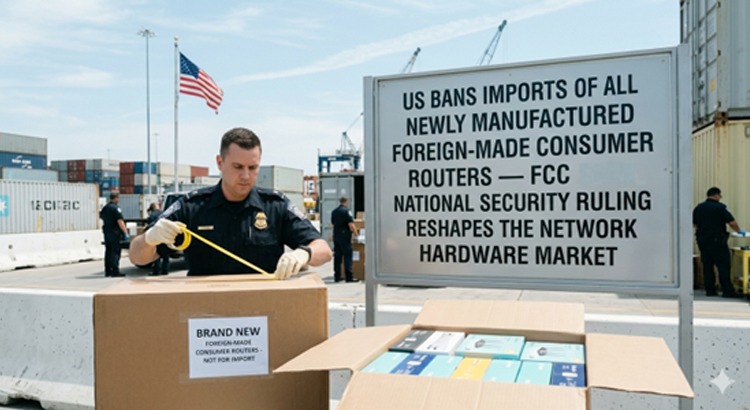
The U.S. Federal Communications Commission formally added foreign-manufactured consumer routers to its ‘covered list’ of communications equipment deemed to present an unacceptable national security risk, effectively banning the import of newly manufactured foreign-made consumer routers into the United States, the Associated Press reported on March 25, 2026. The Trump administration’s action builds on a series of prior FCC covered-list additions that previously restricted or banned Huawei, ZTE, and other Chinese telecommunications equipment from U.S. networks, and extends the scope of the national security hardware policy into the consumer home networking market for the first time. The ruling means that U.S. retailers and distributors will no longer be permitted to import newly manufactured consumer Wi-Fi routers from manufacturers whose products appear on the covered list. The policy has significant downstream implications: it affects telecom equipment supply chains, small businesses that resell networking gear, and millions of consumers who rely on low-cost networking equipment for home broadband. Affected categories potentially include routers manufactured by TP-Link and several other brands with significant U.S. market share. The Department of Justice had previously launched an investigation into TP-Link over potential national security concerns. The router ban adds to what analysts describe as a growing use of national security frameworks as industrial policy — using security concerns to determine which hardware is permitted in U.S. markets, and by extension which manufacturers can serve the U.S. consumer market. Poland simultaneously reported a 150% increase in cyberattacks in 2025 compared to the prior year, with European governments warning of an increasingly hostile cyber environment linked to geopolitical tensions.
US Bans Imports of All Newly Manufactured Foreign-Made Consumer Routers — FCC National Security Ruling Reshapes the Network Hardware Market
104
