


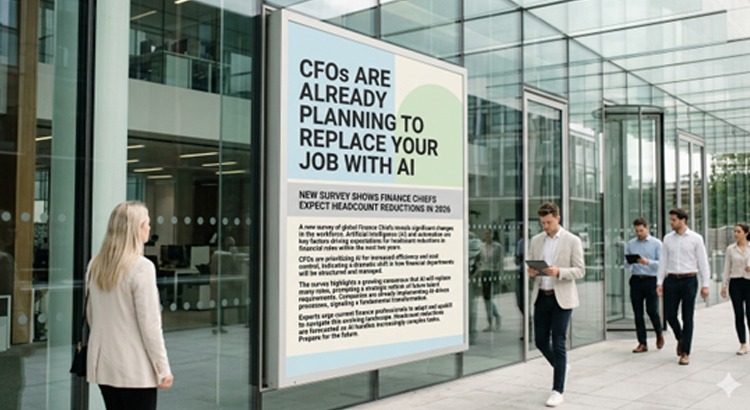
A survey of chief financial officers at major corporations reported by the Wall Street Journal has found that a majority of finance leaders now expect artificial intelligence to contribute to reduced headcount at their organisations in 2026 — with administrative roles, data processing, and routine knowledge-work functions identified as particularly exposed. Academic researchers writing for The Conversation place this CFO-level expectation in a broader context: the shift from viewing AI as a productivity enhancement tool to treating it as a labour substitution tool represents a qualitative change in boardroom planning assumptions that will have consequences well beyond the immediate wave of affected roles. The researchers document a pattern across multiple industries in which AI deployment initially focuses on augmenting human capability — helping workers do their existing jobs more efficiently — before the economics of the technology create pressure to ask whether the human role is required at all. In knowledge-intensive professions, where the work product is information, analysis, or communication rather than a physical object, the barrier to AI substitution is lower than in roles requiring physical dexterity, emotional judgment, or real-time human interaction. The survey data suggests that CFO planning assumptions have already moved: AI is no longer a future consideration in workforce budgeting but a current factor. The immediate impacts are projected to be selective rather than sweeping — concentrated in specific roles rather than broad-based layoffs — but the signal from senior finance executives is that AI-driven efficiency gains are being built into 2026 staffing and productivity assumptions across a wide range of organisations. Academic researchers argue that the most consequential policy question this raises is not whether AI will affect employment, but whether educational systems, government social safety nets, and professional development frameworks are adapting quickly enough to the changing skills landscape that these corporate planning assumptions are already reflecting. The researchers conclude with recommendations for workers, organisations, and policymakers — and note that the companies and workers best positioned for the transition are those who treat AI fluency as a core professional competency today rather than a future skill to be acquired later.
CFOs Are Already Planning to Replace Your Job With AI — New Survey Shows Finance Chiefs Expect Headcount Reductions in 2026
117
