


25
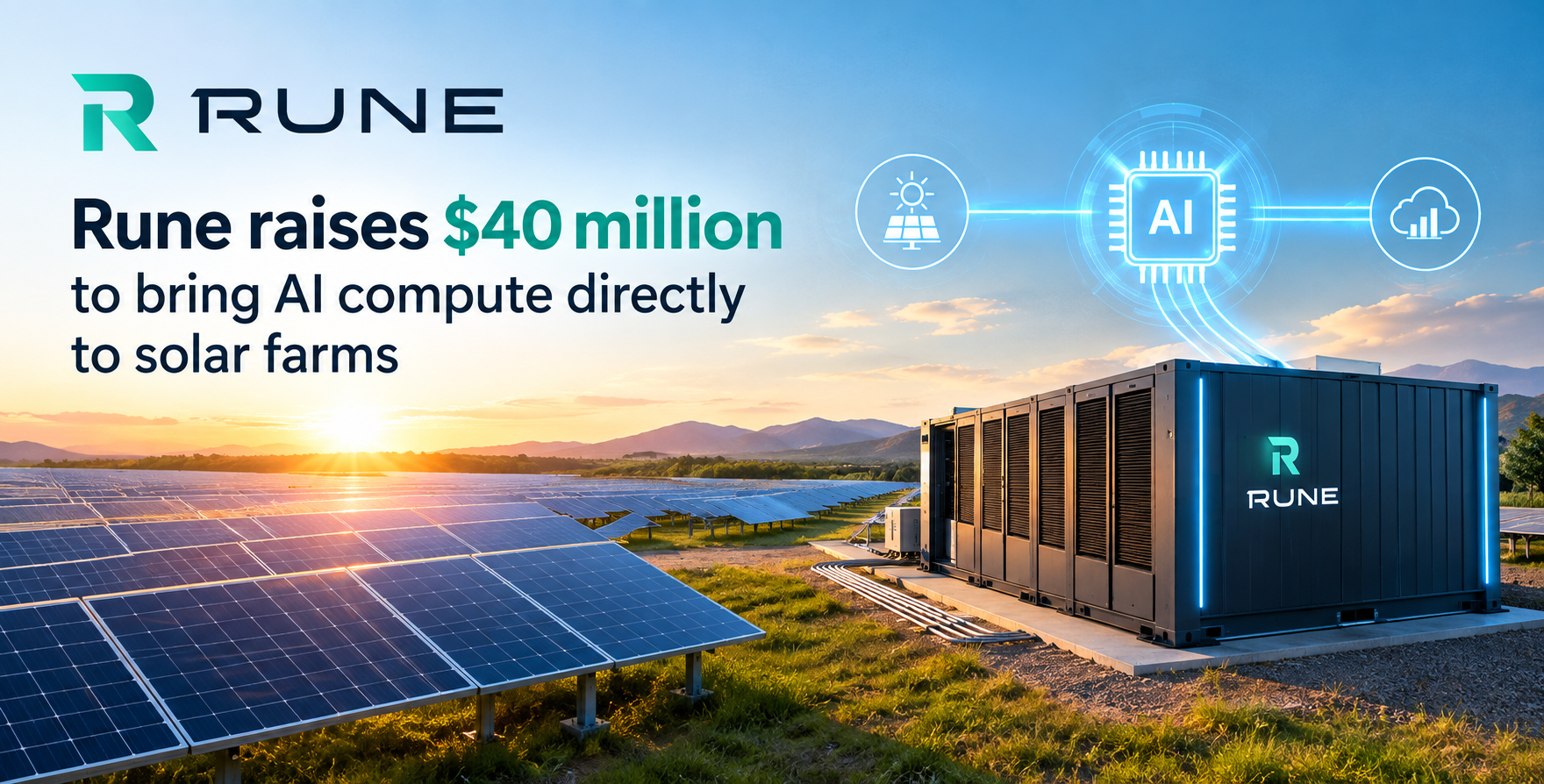
AI infrastructure startup Rune has raised $40 million in Series A funding as it works to deploy AI
computing infrastructure directly at renewable-energy sites, including solar farms.
The funding round was led by Spark Capital, with participation from Union Square Ventures, Lowercarbon Capital, Activate Capital, Committed Capital, Timeless Partners and Logos Fund.
According to Rune, the latest round takes its total disclosed funding to $53.5 million. Alongside the funding announcement, Rune introduced RELIC, short for Renewable Energy Linked Intelligent Compute. The modular system is designed to place computing infrastructure at renewable-energy generation sites and use electricity produced locally to power AI workloads.
Rune's model focuses on using renewable power that may otherwise be curtailed or difficult to deliver to the grid. Instead of building a conventional data centre and waiting for a new grid connection, the company wants to deploy computing infrastructure alongside existing renewable-energy facilities. Rune says this approach can reduce the need for some of the power and infrastructure work associated with traditional data-centre projects.
The company says RELIC can use direct-current power generated by solar panels, potentially reducing some of the electricity-conversion steps involved in conventional data-centre setups.
Rune claims the system can reduce non-compute infrastructure costs by as much as 85% compared with conventional AI data-centre deployments. The figure is based on the company's own estimate and has not been independently verified. Rune has disclosed its first RELIC deployment at a 200-megawatt solar facility in Texas.
The company says the modular system was installed without constructing a conventional data centre or making major changes to the site.
The RELIC units are designed to house AI computing hardware along with the power- management and cooling systems needed to operate it. Rune says its modules can be configured for different workloads, with larger setups supporting up to 1,024 GPUs. The company also claims a RELIC unit can be installed in around an hour, while customers can begin using the computing capacity in as little as six weeks. Actual deployment times can vary depending on the site and infrastructure requirements.
The move comes as the rapid expansion of AI services is increasing demand for computing capacity and electricity. Data-centre operators are facing challenges around power availability, grid connections, construction timelines and the infrastructure needed to support high- performance AI hardware. Rune's approach is to locate computing capacity closer to where renewable electricity is generated, rather than relying entirely on large, grid-connected data centres.
The company is initially focusing on solar power but has indicated that it plans to expand the model to other renewable-energy sites, including wind farms. Rune plans to use the new funding to expand its technology and increase deployments across the AI infrastructure and renewable-energy markets.
The company is betting that placing AI computing closer to renewable power sources can provide another way to address the industry's growing demand for electricity and data-centre capacity.
The funding round was led by Spark Capital, with participation from Union Square Ventures, Lowercarbon Capital, Activate Capital, Committed Capital, Timeless Partners and Logos Fund.
According to Rune, the latest round takes its total disclosed funding to $53.5 million. Alongside the funding announcement, Rune introduced RELIC, short for Renewable Energy Linked Intelligent Compute. The modular system is designed to place computing infrastructure at renewable-energy generation sites and use electricity produced locally to power AI workloads.
Rune's model focuses on using renewable power that may otherwise be curtailed or difficult to deliver to the grid. Instead of building a conventional data centre and waiting for a new grid connection, the company wants to deploy computing infrastructure alongside existing renewable-energy facilities. Rune says this approach can reduce the need for some of the power and infrastructure work associated with traditional data-centre projects.
The company says RELIC can use direct-current power generated by solar panels, potentially reducing some of the electricity-conversion steps involved in conventional data-centre setups.
Rune claims the system can reduce non-compute infrastructure costs by as much as 85% compared with conventional AI data-centre deployments. The figure is based on the company's own estimate and has not been independently verified. Rune has disclosed its first RELIC deployment at a 200-megawatt solar facility in Texas.
The company says the modular system was installed without constructing a conventional data centre or making major changes to the site.
The RELIC units are designed to house AI computing hardware along with the power- management and cooling systems needed to operate it. Rune says its modules can be configured for different workloads, with larger setups supporting up to 1,024 GPUs. The company also claims a RELIC unit can be installed in around an hour, while customers can begin using the computing capacity in as little as six weeks. Actual deployment times can vary depending on the site and infrastructure requirements.
The move comes as the rapid expansion of AI services is increasing demand for computing capacity and electricity. Data-centre operators are facing challenges around power availability, grid connections, construction timelines and the infrastructure needed to support high- performance AI hardware. Rune's approach is to locate computing capacity closer to where renewable electricity is generated, rather than relying entirely on large, grid-connected data centres.
The company is initially focusing on solar power but has indicated that it plans to expand the model to other renewable-energy sites, including wind farms. Rune plans to use the new funding to expand its technology and increase deployments across the AI infrastructure and renewable-energy markets.
The company is betting that placing AI computing closer to renewable power sources can provide another way to address the industry's growing demand for electricity and data-centre capacity.
