


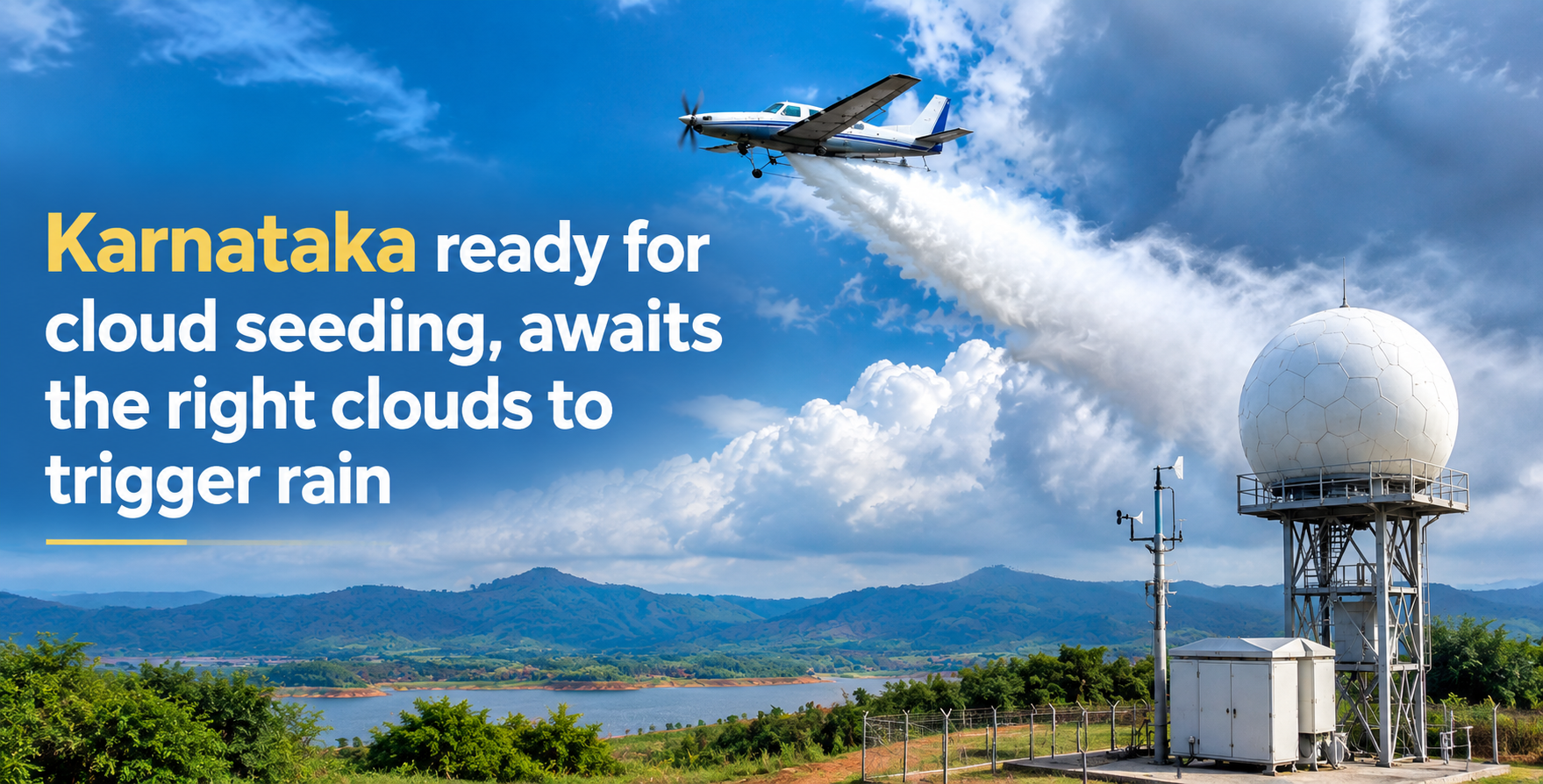
Karnataka has completed preparations for its cloud-seeding programme, but the operation now
awaits the right weather conditions.
Chief Minister D K Shivakumar said on September 18 that the state had made progress on the
cloud-seeding exercise and that the agency assigned to carry it out would move to the required
locations once suitable cloud formations are identified.
The development follows Karnataka's formal launch of its ₹28.52-crore cloud-seeding
programme earlier this month. A specially equipped light aircraft was flagged off from
Bengaluru’s HAL Airport on September 4 as part of the state's efforts to address rainfall
shortages and reduce the risk of water scarcity.
Karnataka has been facing rainfall shortages in several parts of the state, raising concerns over
water availability and agricultural conditions.
The state had earlier received administrative approval for a 60-day cloud-seeding programme.
The government said the exercise would focus on areas experiencing rainfall deficits, major
reservoir catchments and locations facing agricultural distress.
The technology works by introducing suitable particles into existing moisture-bearing clouds to
encourage the formation or growth of water droplets or ice particles.
Whether the process can
produce additional rainfall depends on the type of cloud, moisture levels, temperature, wind and
other atmospheric conditions.
Karnataka's technical teams will use weather information, including data from Doppler radar, to
identify clouds that could be suitable for seeding.
Once suitable formations are detected, the specially equipped aircraft can be deployed to the
area. Depending on the cloud conditions and the technique being used, seeding materials can
include substances such as silver iodide, potassium iodide, dry ice or sodium chloride.
The state's Karnataka State Natural Disaster Monitoring Centre (KSNDMC) is playing a key
technical role in the programme. An eight-member technical advisory and evaluation committee
has been formed to provide guidance and assess the operation's impact, with weather and
operational information being updated at regular intervals.
The biggest limitation for Karnataka at the moment is not the aircraft or the operational
arrangements — it is the availability of suitable clouds.
Earlier this month, weather officials cautioned that atmospheric conditions were not favourable
for cloud seeding. They said sufficiently developed cumulus or cumulonimbus clouds, adequate
moisture and favourable wind conditions are required for the operation to have a reasonable
chance of producing rainfall.
That explains why the state is not assigning the aircraft to fixed locations in advance. Instead,
operations are expected to be triggered by real-time weather assessments.
The government has said the agency will move once suitable cloud formations are identified.
The aircraft will therefore be deployed based on weather conditions rather than a fixed
schedule.
Karnataka's earlier cloud-seeding efforts were reported to have achieved a success rate of
around 35%, according to the state's Water Resources Minister when the current programme
was launched.
The current ₹28.52-crore programme is consequently being watched closely, particularly as the
state tries to improve water availability amid rainfall deficits.
For now, Karnataka has the aircraft, technical teams and monitoring systems ready.
The next
step depends on something the government cannot control: the formation of clouds with enough
moisture and the right atmospheric conditions for cloud seeding to be attempted.
