


18
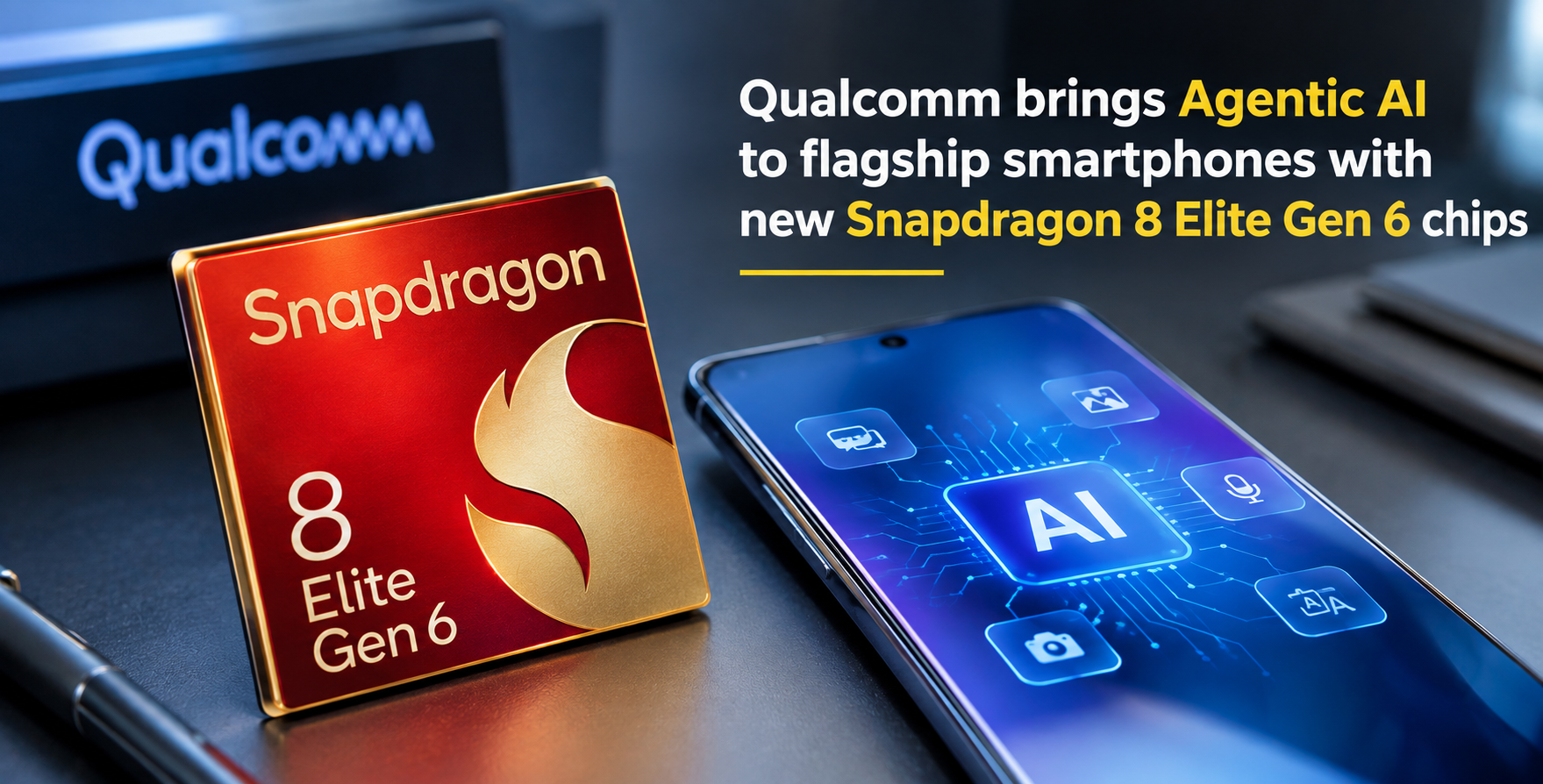
Qualcomm has unveiled two new flagship smartphone platforms designed to bring more advanced artificial intelligence capabilities directly to premium Android devices.
The company announced the Snapdragon 8 Elite Extreme Gen 6 and Snapdragon 8 Elite Gen 6
at its Snapdragon Summit, positioning the new chips around what it calls the emerging era of
agentic AI.
Unlike conventional AI assistants that primarily respond to individual commands, agentic AI is designed to understand context, reason through tasks, and take actions on a user's behalf. Qualcomm is positioning its latest mobile platforms to support these experiences directly on the device.
The new Snapdragon platforms combine Qualcomm's custom Oryon CPU, Adreno GPU and Hexagon NPU to handle demanding workloads involving AI, graphics and other smartphone functions. The Snapdragon 8 Elite Gen 6 is built using a 2nm process, while the new architecture is designed to keep more AI processing on the smartphone.
Qualcomm has also upgraded its Hexagon NPU architecture for agentic AI workloads. The company says its design is intended to support longer context, multiple concurrent tasks, and low-latency AI processing while keeping more model data close to the processor.
This could allow future smartphones to perform more AI operations without continuously sending information to cloud servers. On-device processing can also reduce latency and can provide greater control over sensitive personal information, although the experience will depend on how smartphone manufacturers and software developers implement the technology.
The Snapdragon 8 Elite Extreme Gen 6 sits at the top of Qualcomm's new mobile lineup and is aimed at the highest-end smartphones. Qualcomm says it is designed to deliver faster and more personalised AI experiences while also improving gaming and camera capabilities.
The standard Snapdragon 8 Elite Gen 6 brings many of the same AI, gaming, imaging and connectivity capabilities to a broader range of premium smartphones. Both platforms use Qualcomm's Oryon CPU, Adreno GPU, and Hexagon NPU architecture.
Qualcomm is also integrating AI into graphics processing. Its Adreno Neural Fusion technology is designed to use AI for graphics workloads, while the company has highlighted AI-powered camera capabilities aimed at improving scene understanding and image and video quality.
Qualcomm said smartphones powered by the new platforms will be launched by several major manufacturers, including HONOR, iQOO, Motorola, OnePlus, OPPO, REDMI, RedMagic, vivo and Xiaomi.
The announcement comes as smartphone makers increasingly use AI capabilities as a differentiating feature in premium devices. Qualcomm's latest approach moves the focus
beyond generative AI features such as image creation and text assistance toward systems that can potentially perform multi-step tasks for users.
For consumers, the next generation of flagship smartphones could therefore see AI become less of a standalone feature and more deeply integrated into everyday phone operations. Qualcomm's strategy reflects a broader industry push to make smartphones more capable of understanding user intent, processing information locally and acting as personalised AI platforms.
Unlike conventional AI assistants that primarily respond to individual commands, agentic AI is designed to understand context, reason through tasks, and take actions on a user's behalf. Qualcomm is positioning its latest mobile platforms to support these experiences directly on the device.
The new Snapdragon platforms combine Qualcomm's custom Oryon CPU, Adreno GPU and Hexagon NPU to handle demanding workloads involving AI, graphics and other smartphone functions. The Snapdragon 8 Elite Gen 6 is built using a 2nm process, while the new architecture is designed to keep more AI processing on the smartphone.
Qualcomm has also upgraded its Hexagon NPU architecture for agentic AI workloads. The company says its design is intended to support longer context, multiple concurrent tasks, and low-latency AI processing while keeping more model data close to the processor.
This could allow future smartphones to perform more AI operations without continuously sending information to cloud servers. On-device processing can also reduce latency and can provide greater control over sensitive personal information, although the experience will depend on how smartphone manufacturers and software developers implement the technology.
The Snapdragon 8 Elite Extreme Gen 6 sits at the top of Qualcomm's new mobile lineup and is aimed at the highest-end smartphones. Qualcomm says it is designed to deliver faster and more personalised AI experiences while also improving gaming and camera capabilities.
The standard Snapdragon 8 Elite Gen 6 brings many of the same AI, gaming, imaging and connectivity capabilities to a broader range of premium smartphones. Both platforms use Qualcomm's Oryon CPU, Adreno GPU, and Hexagon NPU architecture.
Qualcomm is also integrating AI into graphics processing. Its Adreno Neural Fusion technology is designed to use AI for graphics workloads, while the company has highlighted AI-powered camera capabilities aimed at improving scene understanding and image and video quality.
Qualcomm said smartphones powered by the new platforms will be launched by several major manufacturers, including HONOR, iQOO, Motorola, OnePlus, OPPO, REDMI, RedMagic, vivo and Xiaomi.
The announcement comes as smartphone makers increasingly use AI capabilities as a differentiating feature in premium devices. Qualcomm's latest approach moves the focus
beyond generative AI features such as image creation and text assistance toward systems that can potentially perform multi-step tasks for users.
For consumers, the next generation of flagship smartphones could therefore see AI become less of a standalone feature and more deeply integrated into everyday phone operations. Qualcomm's strategy reflects a broader industry push to make smartphones more capable of understanding user intent, processing information locally and acting as personalised AI platforms.
