


14
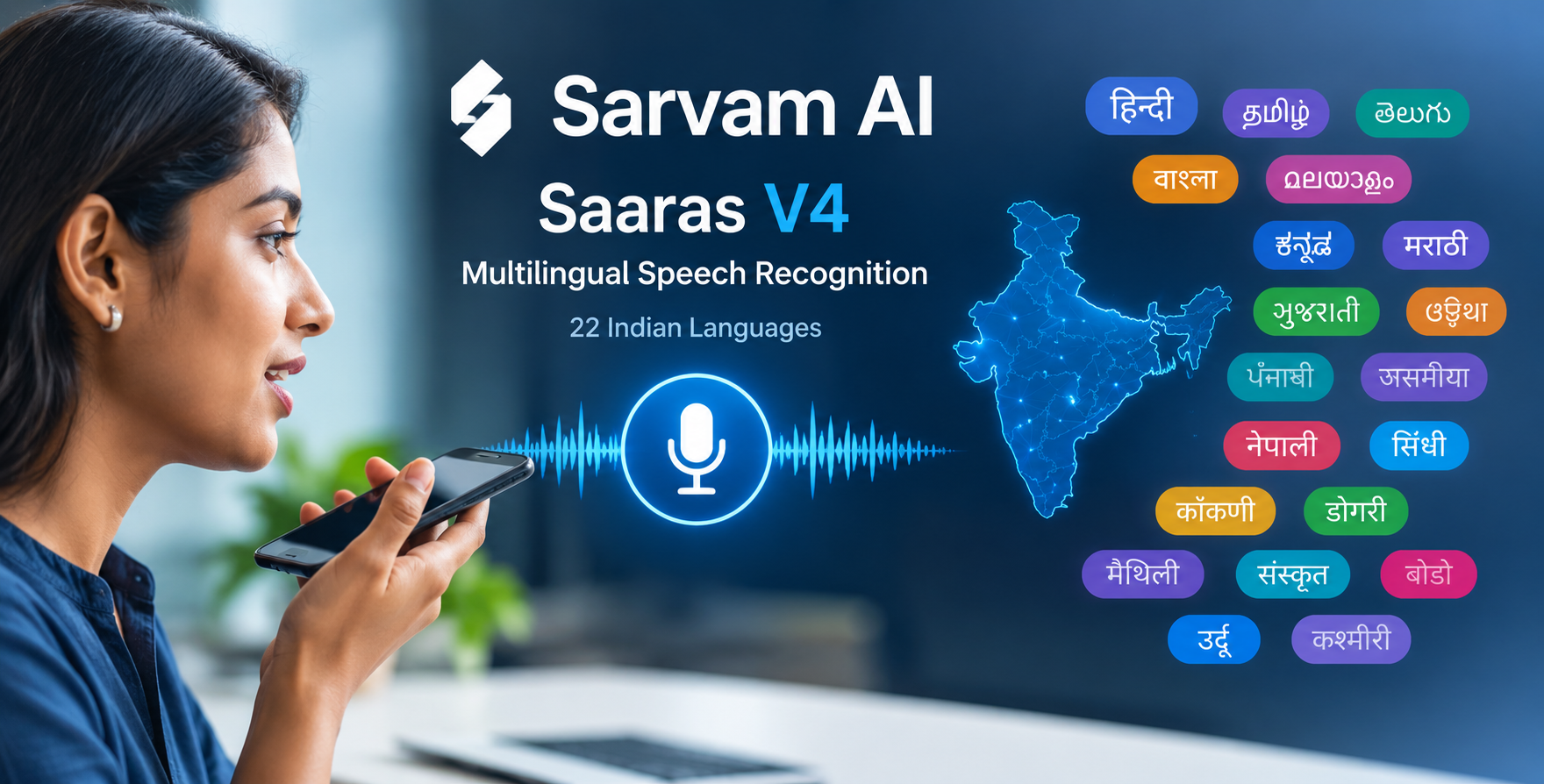
Indian artificial intelligence company Sarvam AI has launched Saaras V4, its latest automatic speech recognition (ASR) model designed to process speech across Indian languages and
English.
The model supports 22 Indian languages along with English and offers five output formats — verbatim transcription, normalised text, code-mixed text, transliteration and translation.
Saaras V4 uses an audio encoder combined with a 3-billion-parameter hybrid state-spacelanguage model developed by Sarvam AI. The company says the model has been designed to process speech affected by background noise, dialect variations, accents, and code-mixing, where speakers switch between Indian languages and English.
The model can also identify the language being spoken and generate text in the corresponding script. According to Sarvam AI, its language-identification error rate was 5.22% across 22 Indian languages and 2.9% across the 10 most widely spoken Indian languages in its testing. Another feature is keyterm prompting, which allows developers to provide specific names, brands, acronyms, and specialised terms that the system should recognise during transcription. This is aimed at reducing errors involving terminology that may be uncommon in general speech data.
Sarvam AI has evaluated Saaras V4 on several speech-recognition benchmarks. For English,the company says the model was tested across seven datasets. Indian-language performance was evaluated using the Vistaar benchmark across 10 languages.
The model also supports real-time speech processing. Sarvam AI reports a time to first token ofless than 150 milliseconds for streaming applications.
Saaras V4 can process long-form audio and is available through Sarvam's API. Developers can also access the model through Python and Node.js SDKs, while integrations are available for platforms including Vercel AI SDK, LiveKit Agents and Pipecat Agents.
The launch comes as Indian AI companies continue to develop speech and language models designed for the country's multilingual digital environment. Applications for the model include speech transcription, voice agents, call analytics, meetings and other systems that rely on converting spoken language into text.
Sarvam AI has positioned Saaras V4 as a single speech-recognition system capable of handling multiple Indian languages, rather than requiring separate recognition systems for individual languages.
The model supports 22 Indian languages along with English and offers five output formats — verbatim transcription, normalised text, code-mixed text, transliteration and translation.
Saaras V4 uses an audio encoder combined with a 3-billion-parameter hybrid state-spacelanguage model developed by Sarvam AI. The company says the model has been designed to process speech affected by background noise, dialect variations, accents, and code-mixing, where speakers switch between Indian languages and English.
The model can also identify the language being spoken and generate text in the corresponding script. According to Sarvam AI, its language-identification error rate was 5.22% across 22 Indian languages and 2.9% across the 10 most widely spoken Indian languages in its testing. Another feature is keyterm prompting, which allows developers to provide specific names, brands, acronyms, and specialised terms that the system should recognise during transcription. This is aimed at reducing errors involving terminology that may be uncommon in general speech data.
Sarvam AI has evaluated Saaras V4 on several speech-recognition benchmarks. For English,the company says the model was tested across seven datasets. Indian-language performance was evaluated using the Vistaar benchmark across 10 languages.
The model also supports real-time speech processing. Sarvam AI reports a time to first token ofless than 150 milliseconds for streaming applications.
Saaras V4 can process long-form audio and is available through Sarvam's API. Developers can also access the model through Python and Node.js SDKs, while integrations are available for platforms including Vercel AI SDK, LiveKit Agents and Pipecat Agents.
The launch comes as Indian AI companies continue to develop speech and language models designed for the country's multilingual digital environment. Applications for the model include speech transcription, voice agents, call analytics, meetings and other systems that rely on converting spoken language into text.
Sarvam AI has positioned Saaras V4 as a single speech-recognition system capable of handling multiple Indian languages, rather than requiring separate recognition systems for individual languages.
