


32
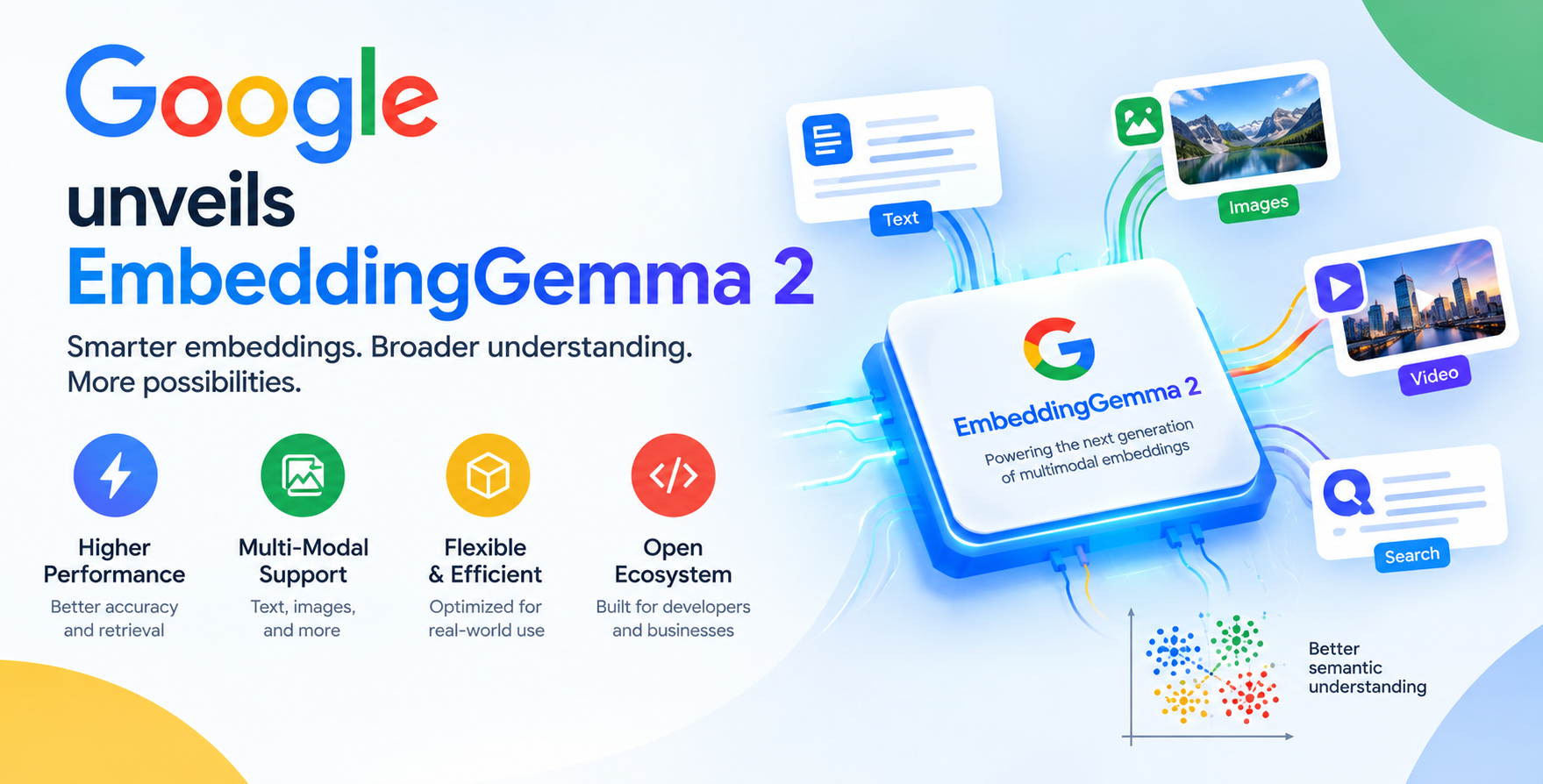
Google has unveiled EmbeddingGemma 2, an open multimodal embedding model designed to bring text, code, images, video and audio into a shared
representation space for AI applications.
Developed by Google DeepMind, the 740-million-parameter model is designed for on-device inference, allowing developers to build AI applications that can process and retrieve information across different types of content. According to the announcement, potential applications include semantic search, retrieval-augmented generation (RAG), classification and clustering.
EmbeddingGemma 2 maps different content types into a shared 768- dimensional vector space, enabling cross-modal search. For example, developers could use a voice query to locate a relevant video clip or search audio recordings using text.
The model uses a modular architecture comprising a 270-million-parameter text and code component, alongside optional vision and audio encoders containing 170 million and 300 million parameters, respectively. This modular design allows developers to load only the components required for a particular application rather than deploying the entire model.
EmbeddingGemma 2 supports an 8,000-token context window and uses Matryoshka Representation Learning to reduce its 768-dimensional output to 512, 256 or 128 dimensions. Google said this approach can reduce vector database storage requirements by up to six times, depending on the configuration.
The model is designed for resource-constrained devices and can support low-latency, offline AI workflows. This could enable developers to build applications that perform search and information retrieval without relying entirely on cloud-based infrastructure.
Google has released EmbeddingGemma 2 under the Apache 2.0 licence, with model weights available for developers to use and modify under the licence's terms.
The launch expands Google’s Gemma family into multimodal embedding technology, giving developers an open model for searching and retrieving information across text, code, images, video and audio. Its on-device design could make it useful for applications that require cross-modal search while managing computing resources and storage requirements.
Developed by Google DeepMind, the 740-million-parameter model is designed for on-device inference, allowing developers to build AI applications that can process and retrieve information across different types of content. According to the announcement, potential applications include semantic search, retrieval-augmented generation (RAG), classification and clustering.
EmbeddingGemma 2 maps different content types into a shared 768- dimensional vector space, enabling cross-modal search. For example, developers could use a voice query to locate a relevant video clip or search audio recordings using text.
The model uses a modular architecture comprising a 270-million-parameter text and code component, alongside optional vision and audio encoders containing 170 million and 300 million parameters, respectively. This modular design allows developers to load only the components required for a particular application rather than deploying the entire model.
EmbeddingGemma 2 supports an 8,000-token context window and uses Matryoshka Representation Learning to reduce its 768-dimensional output to 512, 256 or 128 dimensions. Google said this approach can reduce vector database storage requirements by up to six times, depending on the configuration.
The model is designed for resource-constrained devices and can support low-latency, offline AI workflows. This could enable developers to build applications that perform search and information retrieval without relying entirely on cloud-based infrastructure.
Google has released EmbeddingGemma 2 under the Apache 2.0 licence, with model weights available for developers to use and modify under the licence's terms.
The launch expands Google’s Gemma family into multimodal embedding technology, giving developers an open model for searching and retrieving information across text, code, images, video and audio. Its on-device design could make it useful for applications that require cross-modal search while managing computing resources and storage requirements.
